
Category: the world

“[T]hings both in heaven and in the earth, and under the earth; things which have been, things which are, things which must shortly come to pass; things which are at home, things which are abroad; the wars and the perplexities of the nations, and the judgments which are on the land; and a knowledge also of countries and of kingdoms—” Doctrine and Covenants 88:79

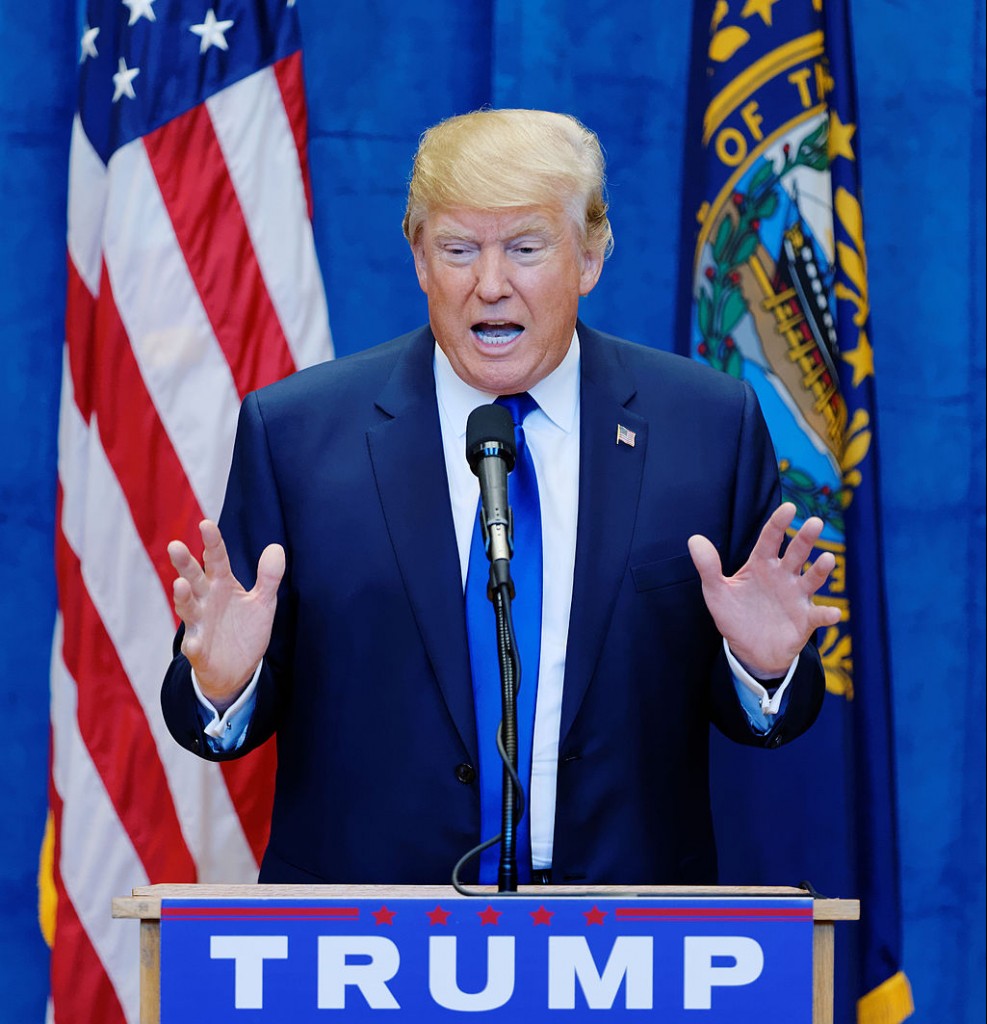
  • Dump Trump

    By Michael Vadon. CC-BY-SA 4.0

    Can we as a nation finally be done with Donald Trump? He doesn’t just talk nonsense—these days he actively spews the worst of ideas, verging on Hitlerian.

    For example, today in an official campaign press release candidate Trump proposed barring all Muslims from entering the country:

    Donald J. Trump is calling for a total and complete shutdown of Muslims entering the United States until our country’s representatives can figure out what is going on.

    This follows his support for surveillance of mosques and his publicly declared openness to requiring all Muslims to register in a national database.

    Mr. Trump did not immediately unveil plans for a Final Solution to the Muslim Question, but we can expect this any day now.

    Not convinced that Trump is in the wrong?

    Imagine that instead of Islam it is your religion or your ethnic group or whatever that he’s targeting. For example:

    Donald J. Trump is calling for a total and complete shutdown of white people entering the United States until our country’s representatives can figure out what is going on.

    Donald J. Trump is calling for a total and complete shutdown of Christians entering the United States until our country’s representatives can figure out what is going on.

    Donald J. Trump is calling for a total and complete shutdown of women entering the United States until our country’s representatives can figure out what is going on.

    Treating all of Islam as our enemy makes 23% of the world’s population our enemy. That’s insane. It’s almost the least effective possible way to attempt to target terrorists—it’s a class of people so large that it’s almost meaningless. It’s not too far removed from, for example, targeting all men simply because most terrorists are men.

    I hope that this outrageous man has finally crossed some line with his supporters and that his candidacy will soon go down in flames. And yet I don’t actually expect that to happen, given his resiliency so far. But please, America, let’s keep this man as far away from the presidency as we can manage.

  • France and America

    Me and EiffelFrance is a lovely country. Paris, a delightful city. The attacks last week were a disgusting expression of an empty ideology that hurts its practitioners and its victims both.

    The outpouring of support and solidarity that people around me have shown for France frankly caught me by surprise. It seems we’re past the old pettiness of “freedom fries” and francophobia. I say it’s an improvement. In the long run I think it’s our natural state to have these warm fraternal feelings for France, at very least because we Americans owe the French a great debt of gratitude for their assistance in the Revolutionary War. In 1919, shortly after the First World War, Woodrow Wilson urged the Senate to sign a treaty with France, declaring:

    We are bound to France by ties of friendship which we have always regarded, and shall always regard, as peculiarly sacred. She assisted us to win our freedom as a nation. It is seriously to be doubted whether we could have won it without her gallant and timely aid. We have recently had the privilege of assisting in driving enemies, who were also enemies of the world, from her soil; but that does not pay our debt to her. Nothing can pay such a debt. She now desires that we should promise to lend our great force to keep her safe against the power she has had most reason to fear…. A new day has dawned. Old antagonisms are forgotten. The common cause of freedom and enlightenment has created new comradeships and a new perception of what it is wise and necessary for great nations to do to free the world of intolerable fear.

    —Message of President Wilson Transmitting to the Senate the Treaty with France of June 28, 1919

    We seem to be in a new age of needing to “free the world of intolerable fear”, and these nearly century-old words are strikingly relevant today. But the pro-French fervor in the air right now is concerning as well as inspiring. It reminds me strongly of the feeling immediately after the September 11th attacks. There’s the unity in the face of violence and madness, the cohesion around what makes our western culture distinctive, but there’s also the risk of overreacting and bumbling our way into quagmires.

    It seems France is already proceeding down that road. Their first instinct now is the same we acted out in the United States after our national tragedy 14 years ago: to solve the problem by militarizing it. An attack on us killing X people becomes hundreds of attacks in a foreign land killing 100X people, inspiring a new generation of terrorists who will wish to avenge their dead comrades, wives, and children.

    At Versailles 4 June 2007

    In fact, last week’s attacks seem partly to be a consequence of America’s overreaction to 9/11. We invaded Iraq, then we got out, leaving a feeble government that provided fertile ground for the growth of the Islamic State—the very organization claiming credit for the attacks in Paris. And so we see violence begetting violence begetting violence.

    We need to take the Islamic State threat seriously. We need to find ways to tackle the root causes of these attacks—to help people to stop wanting to attack us and our way of life. The terrorist attacks aren’t the problem—they’re a symptom of underlying problems of political oppression, economic stagnation, and deep-seated anger at bearing the brunt of various American and European imperialist projects through the decades.

    But why am I telling you this? Isn’t this obvious to everybody, hasn’t it been for the last 14 years? Don’t we all realize already that neither we, nor the French, nor anyone else, can war our way out of this problem?

    I hope it is obvious. Maybe military action will be necessary, but then again, maybe it does more harm than good. At very least it must be recognized for the worst-case option that it is. Every time we resort to it, we do so because we’re still losing the war of ideas.

    Until we start fighting and winning in the realm of ideology, these attacks will keep happening, no matter the military hardware, nor the sweeping surveillance powers, nor the national security state we throw at it.

    On résiste à l’invasion des armées; on ne résiste pas à l’invasion des idées.
    One withstands the invasion of armies; one does not withstand the invasion of ideas.

    —Victor Hugo, “History of a Crime”, Conclusion, Chapter 10
  • A Fig Leaf

    There is a major separation of powers issue with the current surveillance arrangement:

    The standard for permitting a query of the database of internal US phone calls is a “reasonable, articulable suspicion” of terrorist activity, Inglis says.

    Only 20 analysts within the NSA are empowered to approve targeting US-based phone conversations, he says. One of those 20 analysts, or their two supervisors – 22 people total – must sign off on any domestic targeting, he says. [link]

    The intelligence and law enforcement officials as subject to “checks and balances“. But they clarified, in the most detail provided publicly thus far, that most of those checks are internal.

    James Cole, the deputy attorney general, said that the NSA needs “reasonable, articulable suspicion” of involvement in terrorism before searching the millions of Americans’ phone records that it collects. But, Cole said: “We do not have to get separate court approval for each query.”

    Instead, the NSA sends an “aggregate number” of times it has searched the database every 30 days to the secret Fisa court that oversees surveillance, while also sending a separate report each time NSA analysts inappropriately search the database. Alexander’s deputy, Chris Ingliss, said NSA analysts searched the database 300 times in 2012 in total.

    Representative Adam Schiff, Democrat of California, said that “it may be valuable to have court review prospectively”. [link]

    So 22 people in an executive branch agency decide for themselves whether a search of millions of records of communications involving American citizens should go forward, and then tell a judge once a month how many times they searched the database. Fourth Amendment refresher:

    The right of the people to be secure in their persons, houses, papers, and effects, against unreasonable searches and seizures, shall not be violated, and no Warrants shall issue, but upon probable cause, supported by Oath or affirmation, and particularly describing the place to be searched, and the persons or things to be seized.

    Key phraseology: “particularly describing“, “to be searched”, “to be seized”

    The warrant is to issue before the search takes place, and there must be a specific description to the issuing authority of the search to be performed. From all appearances, neither of these conditions are satisfied by the NSA’s internal controls on its surveillance tools.

    NSA employees are acting as their own judges, issuing their own warrants, and then asking for the FISA court’s rubber-stamp approval after the fact. NSA’s arrangement seeks judicial oversight for searches up to one month after they’re already carried out. All evidence gathered through these methods would be inadmissable before any normal, non-secret court. There’s zero value in getting a warrant after the search or seizure has been executed: by then, it’s too late, liberties have already been violated, and any objection by a judge after the fact would be a dead letter.

    This is a fig leaf, pure and simple, and while it may make the president and others in government feel good that they are going to great lengths to supposedly protect our civil liberties, it seems to me clearly unconstitutional. And we’re still left with the apparent fact that our government has massive troves of data on American citizens that can be mined in the first place. Again I assert that the value of such data is so great that it will inevitably be abused. Furthermore, knowledge that we are being watched constantly will have a chilling effect on free society and culture. And we depart further from the republican ideal the less public our republic becomes.