Category: the world

“[T]hings both in heaven and in the earth, and under the earth; things which have been, things which are, things which must shortly come to pass; things which are at home, things which are abroad; the wars and the perplexities of the nations, and the judgments which are on the land; and a knowledge also of countries and of kingdoms—” Doctrine and Covenants 88:79

  • On the War

    Vietnamescape
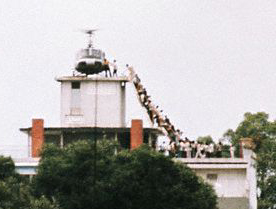
    The Americans bailed, let’s get out of here! (Vietnam 1975? Iraq 20×6?)

    [Note: this article is a reposting of something I wrote for my family-only blog. It seems to be appropriate for general circulation, though, and I now present it with only the slightest editing.]

    I sort of think fighting over politics is like Bible bashing: totally unproductive. Why fight over the Good News? Why start a war talking about a war? With these risks in mind, I do want to throw in a few thoughts of mine.

    Those Who Cannot Remember the Past are Condemned to Repeat It

    It’s important to keep things in perspective. The failure of the Treaty of Versailles after WWI taught the Allies to do things differently after WWII. The debacle of the collapse of South Vietnam after U.S. withdrawal there should teach us to do things differently with Iraq. What happened when the United States pulled out of Vietnam? The Democratic Congress refused to finance further military operations in Vietnam and the south of that country was swept over by the communist forces, hundreds of thousands of people were sent to “re-education” camps as punishment for “collaborating” with the Americans during the war, and Vietnam embarked on a 20 year epoch of isolation from which it has only recently been emerging, at least economically. Vietnam has yet to grant freedoms of religion or speech, and represses those liberties far more rigorously than the Chinese Communists do. (For more information on the withdrawal and the Communist takeover see Operation Frequent Wind and Fall of Saigon in Wikipedia.)

    Contrast that with South Korea, where the U.S. forces did not withdraw. South Korea allows full freedom of expression and religion, and turns out to be the world’s 13th largest economy, ahead of Australia and Russia. More recent data shows that Russian and perhaps Australia have leaped ahead of South Korea in economic output since I originally posted this.)) If American support for the war declined to Vietnam-like levels, we may have withdrawn, subjecting the entire Korean peninsula to the benighted state currently reserved for the pitiable North.

    Comparing the Costs

    Significantly, nearly 60,000 U.S. soldiers died in Vietnam, twenty times the current casualties in Iraq after 2.5 times as many years. Given the current average casualty rate, it will take about 72 more years for casualties in Iraq to equal casualties in Vietnam. Current spending on Iraq is relatively less than in Vietnam as well. (Of course, 1-2% of the GNP of the United States annually is still an astronomical sum.)

    About 100,000 Americans die every year as a result of alcohol use according to some sources. (According to CDC’s more conservative estimates, “excessive alcohol use was responsible for approximately 75,000 preventable deaths” in the United States in 2001.) “The total cost of alcohol problems is $175.9 billion a year (compared to $114.2 billion for other drug problems and $137 billion for smoking).” (Marin Institute) By contrast, the United States is spending about $120 billion a year in Iraq and Afghanistan combined. We could save twice as much money and hundreds of times more lives by eliminating alcohol and tobacco than we would save by withdrawing from Iraq and Afghanistan. What are our priorities? Is this really all about saving lives and money? Or is it about lack of will, unwillingness to stick with a commitment once we’re bored of it? In the Book of Mormon, it’s clear that the problem the Nephites had with the infestation of robbers had more to do with having the will to do what was necessary to eradicate them than it had to do with having sufficient strength to do so or with being morally justified in doing so. (See Helaman 6:18,20-21,37. The robbers of Gadianton described in the Book of Mormon are a stunningly close parallel to Jihadist terrorists, from their organizational structure to their penchant for hiding out in mountainous regions.)

    43% of marriages contracted today will theoretically end in divorce.

    Many war opponents argue that every life is precious, every soldier’s death is a tragedy. True. But at least they are dieing in the hope of helping a nation onto its feet and into a free, prosperous, peaceful future rather than merely in the pursuit of a high or a quick slosh.

    Having mentioned the Book of Mormon already, I’d like to say that that book does seem to condemn the way in which we entered the war in Iraq. Regardless, we’re there, basically the whole nation agreed to go there, and we have a responsibility to leave things better than we found them.

    Post Mortem

    Was that so bad? If nobody else cared to read it, I’m still glad I wrote it. I feel like, given media coverage, people almost have no option but to hate the war, hate the president, and just “want out.” I have too much respect for myself to simply accept what’s handed to me by CNN or even our favorite student paper, The Daily Universe (which mostly just runs Associated Press stories, anyway). I’ve just had these thoughts bouncing around for a long time, so it’s good to get them out.

    There is danger in unquestioningly supporting a war. But there is also danger in merely accepting the bidding of the popular media. Supporting or opposing the war in light of history, costs, benefits, consequences, that’s getting to the core of the issues.

    I conditionally support the war in Iraq and the President. I think the Democratic majority in Congress—while it brings with it some serious annoyances—is good in motivating the Republican leadership to innovate and find more effective solutions. As bad as things are in Iraq, they will get much, much worse if we abandon those people. Genocide? Not a happy thing. I still feel like the lives of our men and women are being sacrificed for something noble and still actually attainable, a dream that President Bush and I still share to a large degree: a peaceful, free, democratic Iraq.

  • Life

    I recently had a debate with my roommate about a very significant issue: how do we as a society decide whether and for how long individuals in a “permanent vegetative state” (deliberate scare quotes) are kept on life support. Who decides the matter of the prolongation of their lives? There are a few possibilities:

    The Person Himself/Herself?

    Yes, if they clearly indicated while they were conscious that they would prefer not to be kept on life support in such a situation. Living wills? Perhaps every person applying to get a driver’s license could be required to declare their position officially for future reference?

    Parents?

    Are parents normally permitted to cause the death of their child by neglecting their needs such as food and water? Will parents always act in the child’s interest? What if they were tired of taking care of the kid? Do they always know what their child would have done? If you have children, do you know what they would want? Are you willing to pass that information on even if it contradicts with your views?

    The state (bureaucrat, judge, legislators, governor)?

    –Cue Orwellian Doomsday Prophecies–
    It seems like government making such decisions would be a situation to avoid, but that is the status quo in many cases. In most situations I would prefer the parents making the decision over the county judge, a Health Department case worker, the state legislature, the Govern[at]or, the Senate, the President… the U.N. Secretary General….

    The Benthamite Radical Equation

    Scenario: X number of dollars are spent each year to preserve/prolong (fill in the blank depending on your ideology) the life of Individual A on life support. X dollars could alternately be used to invest in AIDS research, inoculation campaigns, prevention programs, or sleep apnea education that would — by prevention or intervention — save the lives of 10 people. This is classic opportunity-cost that leads us to the inevitable conclusion: Individual A has got to go to make room for Individuals B through K. Right?

    If the situation was so simple then the choice would be clear. However, it isn’t so simple. For one thing, there are a ridiculous number of alternatives that X dollars could be used for. More importantly, though, there are many more sources of X dollars than diverting funds from the care of Individual A. Please, take a look at the federal budget for the United States and tell me that there isn’t somewhere else we could pull resources from, something that isn’t a matter of life or death.

    Towards demonstrandum

    Assuming that the value of each human life is equal, let W be the value of one human life. Given that Individual A is supported for one year by an expenditure of X dollars, the support of Individual A yields value per dollar V = W / X = W/X by unit definition.

    Another value-yielding activity is fire ant research. Assuming that Fire Ant Research is less valuable than an individual human being, let us suppose that the value of one year of fire ant research at Tennessee State University is Y = W / 100 (implying that a single human being is exactly 100 times more valuable than TSU fire ant research) and the cost of said research is also X dollars. TSU fire ant research yields value per dollar Z = Y / X = W / 100X. Thus the value per dollar of maintaining Individual A on life support is 100 times the value per dollar of TSU researchers investigating fire ants.

    Supposing that Preventative Measure M can preserve the life of 10 individuals (Individuals B-K) over the same time period with an expenditure of $X, the value per dollar yield of engaging in Preventative Measure M is N = 10W / X. Thus engaging in prevention produces 10 times the value yield of maintaining life support for Individual A.

    After further investigation, we again conclude that Individual A should be removed from life support and allowed to die, and funding should be redirected to Preventative Measure M, thereby increasing the value yield captured by X dollars. Q.E.D.

    …Right?
    Wrong.

    Demonstrandum, Again

    In the above decision we exchanged the W value received by keeping Individual A alive for the 10W received as reward for carrying out Prevention Measure M for a net gain of ?value = 9W. However, if we instead divert funding from fire ant research to Preventative Measure M, which gave a value of W/100, we would have a higher net gain in value: ?value = 10W – W/100 = 9.99 W > 9W. Therefore, funding Preventative Measure M by diverting funding from fire ant research causes greater overall wellbeing doing so using Individual A’s life support money, and we conclude that the best course of action is to continue supporting Individual A and to discontinue TSU’s fire ant program. Q.E.D.

    Right?
    Well… maybe.

    Oh, Be Wise

    In the scenario presented, we have only considered one other opportunity by which to calculate the opportunity cost of preserving A’s life. In reality, there are many, many more opportunities, thus complicating the decision. Given perfect information about the value of each option in terms of resultant wellbeing, the fire ant program would not be eliminated until all other programs, policies, decisions, etc. in support of less effective value sources were eliminated first. Along the same lines, Individual A would not be removed from life support until all other options resulting in less net gain in wellbeing were eliminated. In other words, there is much to consider before we start pulling plugs. As King Benjamin in the Book of Mormon taught, “see that all … things are done in wisdom and order…” [Mosiah 4:27]. I wholeheartedly agree.

  • Counterpoint

    This is my response to the email I received from “La Russophobe,” whose blog I commented on recently. I have to say that this is the most I ever want to become involved with “blog politics.” I’m not particularly interested in explaining and defending my viewpoints at great depth; I really just express them for my own benefit (putting things in writing can clarify your thinking quite a bit) and to show what page I’m on, rather than to engage in any intensive dialectic.

    That said, this letter does serve largely as a defense of my previous position.

    I have taken minor liberties in editing this version for publication.


    La Russophobe,
    I want to thank you for your thoughtful response to my blog post. You raise a large number of interesting points—in fact, so many that I’m sure that I’ll fail to address some of them, for which I apologize. First of all, I apologize for any offense taken at my post. Inasmuch as I ever descend into ad hominem criticism, you are right to point out my hypocrisy.

    Now, as to why I criticize your style. By no means am I coming down against there being variety of rhetorical styles. I am, however, stating why I believe that your particular style, as it has been used throughout the centuries, is less effective than others. My belief is that the use of what you might call “fiery rhetoric” is not conducive to a substantive discussion of the facts. This is not to say that in your posts you do not discuss facts, but rather that it is difficult for me, at least, and I suppose other readers to focus on the core of your arguments because the language is so impassioned. This is part of why I believe that the United States presidential debates are so frustratingly shallow—because the “winner” is whichever candidate can score a rhetorical knockout, rather than the one who presents the most compelling ideas. This is why I seemingly come down in support of Yuri’s blog and his style. When I read his writing, I feel like I’m able to glean valuable insight by learning about a Russian’s perspective on his own country. When I read your writing, I simply feel angry! In my mind you do a disservice to your own work by using attack-style language because it provokes an emotional response that overwhelms the value of your logical argument.

    This brings up something else. What is the goal of your blog? Your stated purpose is “recording the rise (and hopefully fall) of the Neo-Soviet Union.” I am sorry that you have already concluded that Russia is indeed a “Neo-Soviet Union”—an evil state akin to that built by Lenin and Stalin and their successors. While I agree that it is possible that such a situation will come about, I also believe that by deciding that it has already, you actually make it more likely that it will; a self-fulfilling prophecy. Your rhetorical style, as I discussed above, seems aimed at provoking anger, fear, and even hate, which is certainly counter-productive. By provoking fear and hate towards Russia, you make it more likely that Western citizens will call upon their leaders to take an unnecessarily hard line with Russia, which will cause a Russian response and (perhaps) a chain reaction of policies leading to “Cold War 2.” Is that really what you want? Or would you prefer to discuss Russia in a way that causes readers to understand — without engendering fear or hate? In my view, that is what the goal of all Westerners should be concerning Russia. Provoking a negative reaction to Russia may score ratings, but please consider that there are far more important things in this world than the popularity of any blog.

    Finally, I’m just in this for fun, really. It’s an interest of mine. I’m going to be taking a Russian class in the fall, my brother was a missionary in Samara, many of my friends have studied Russian and will be studying in Russia soon. I’m not looking to be a professional lobbyist or anything, but simply to expand my understanding of that country and throw my thoughts out here and there. Also, I’m studying linguistics, which could explain my fascination with your style of writing, or even with your pseudonym (which seems to be an interesting combination of both Greek and Romantic language elements.) I feel like Yuri’s coverage of the child sex exploitation issue was insightful (see his article, Boys For Sale: Russia’s Forgotten Children—a nice tip of the hat to that great musical of the 1960’s, Oliver,) providing a window on Russia that should give Westerners pause. I don’t feel like Yuri posted that information to distract people from what was discussed in the Wall Street Journal article, but to show that the true tragedy of Russia is, and has always been, human rather than political. It’s similar to dissident videos coming out of North Korea that instead of focusing on the glitz of Pyongyang or the intrigue of the nuclear weapons program that attract so much Western media attention, focus on images of little orphan boys, homeless, scrounging scraps of food out of the mud, or of refugees telling of cannibalism in the face of crippling famine and governmental apathy.

    I hope that this gives you a better idea of my views on things. I intend to post both your letter and my response to my blog (though it may take me a day or two to get around to it—it’s the end of a term here at school and I’ve got to go out of town soon) although I’d prefer we keep any further discussion private at least initially. Thanks again for your thoughtfulness and for the time you’ve taken to read my response. I hope that we leave as friends, agreeing to disagree but glad for the open exchange of ideas.

    Take care, and best wishes,
    Josh