Category: economics

  • Mandatory Housing Affordability does not make housing affordable

    Mandatory Housing Affordability does not make housing affordable

    Seattle has MHA zones, and yet rent is what it is. Case in point.

    But if you’d like more evidence than that brute observation, a recent study goes further, finding that housing permits declined in MHA zones in Seattle, while they increased in non-MHA zones. This is effectively a non-result, or a negative result, spitting into the supply-vs-demand wind:

    While the metro area population has grown by 30 percent over the past two decades, Seattle is building fewer new units per year than when it had 1 million fewer inhabitants. As a result, since 2000, median house prices have nearly tripled; one in seven residents is severely rent burdened.

    The core cause of unaffordable housing is there not being enough housing.

    Mandatory Housing Affordability centers on a requirement that a certain percentage of units in new residential buildings be provided at below-market rates to lower-income residents. This requirement is coupled with a relaxation on restrictions to the density of developments.

    The goal is noble, but by imposing a costly requirement on developers, MHA drives developments into non-MHA zones, and possibly prevents some developments ever getting off the ground.

    The MHA zones were presumably zoned with an affordable housing requirement out of a desire to provide affordable housing in that geographical area. Now, perversely, the MHA requirement reduces the new housing actually built in the MHA zone, likely contributing to housing costs in that area.

    Whatever makes sensible housing developments illegal to construct makes housing in general less affordable, by making there be less of it.

    If there were more housing to choose from, people wouldn’t have to pay as much – as recently happened in Austin, TX after a glut of new housing construction.

    Every restriction on housing construction is also, de facto, a restriction on the so-called “wrong type of people” moving into “our” neighborhood – which explains much of their popularity. Zoning laws were the original vehicle of redlining, and still reinforce de facto segregation by preventing different sorts of housing from coexisting in the same area.

    That same concern over “preserving the character of the neighborhood”, I expect, is behind the startling fact that 98% of developments in Seattle MHA zones chose to pay into an affordable housing fund rather than actually providing affordable units.

    In a sense, affordable housing mandates like MHA are trying to artificially reintroduce interesting heterogeneous neighborhoods, made illegal by zoning’s introduction 100 years ago, replaced by the sameness of the zones.

    Without restrictions like minimum lot sizes, a wider range of plots sizes and thus housing types and levels of affordability could possibly coexist in the same neighborhood.

    Minneapolis has pioneered such reforms, with good results, and Washington is following that lead (and Oregon’s and California’s) with HB 1110 allowing duplexes, triplexes, and quadplexes in most neighborhoods, and HB 1337 allowing more accessory dwelling units.

    HBs 1110 and 1337 tackle the root of the affordability problem by making less housing construction illegal – i.e. allowing a greater quantity of sensible housing to be built. Many more reforms of that sort can, and should be made soon.

    Increasing housing supply is the only path toward actually making housing affordable. A proper respect for material reality, rather than misguided mandates, will pave the way.

  • Taxation

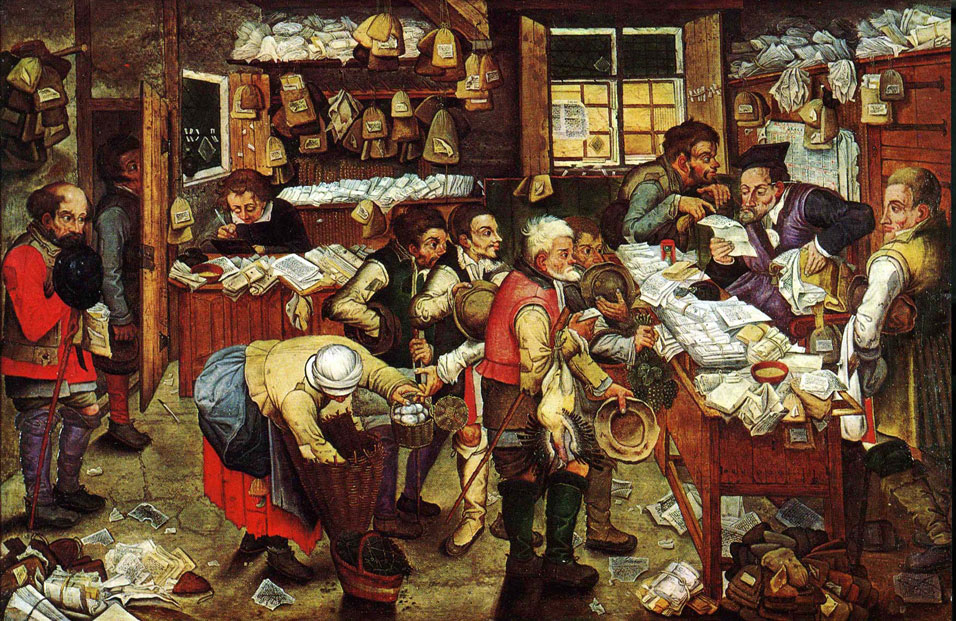
    An American submits his 2017 tax return to the IRS. Err, nevermind, this is from the Netherlands in 1640. (Pieter Brueghel the Younger, The tax collector’s office)

    There’s a reason why every year I put off filing my taxes until almost the last possible moment. I usually just chalk it up to my ingrained habit of procrastination, and I’m sure that’s at least part of the story. But the real reason is that paying taxes in the United States is a nightmare.

    Repeated TurboTax upsell attempts. Adding up all my Internet purchases so I can pay the Utah state “use” tax (a tax on _using_ things). Navigating a maze of credits, deductions, and ridiculous economic situations I’ve never even heard of but that could land me in hot water if I misunderstand. Did I sell that stock? Was that checkbox checked? Is this box greater than this box plus that box? This is freaking 2017. This whole thing should be automated. An algorithm. You know—computers doing calculations for us, executing well-defined rules for us _so we don’t have to._ Instead every American once a year spends hours and/or a bunch of money on this dance, searching for ways of clawing money back from the government. This isn’t taxation by rule of law—it’s taxation by incomprehensible bureaucratic procedure.

    There should be one way to calculate your taxes, something well-defined that a computer can do for you. Something so transparent and straightforward that the IRS just says “You owe this much and this is why” and you say “Yup, that looks right” and click “Pay” or “Refund” and bam, you’re done.

    But instead the tax prep industry and Grover Norquist alike lobby congress to keep the whole thing a mess so the status quo will continue: you’ll pay exorbitant sums to make somebody do your taxes for you, and you’ll hate hate hate taxes.

    It doesn’t have to be this way. What if it was simple, understandable, and easy? What if it was clear that you were paying your fair share, and that everybody else was, too, and instead of a manual, form-filling, mind-boggling nightmare that mashes 1950s technology with all the worst of 2010s porkbarrel politics, we had a straightforward, sane, modern tax system we could even say we were proud of?

    2017.

    2017 you guys.

    2017.

  • Ideologue-y

    Do you ever feel that the previous generation just sees you as another potential acolyte to be indoctrinated and enlisted to fight the next big ideological war? In several situations I have felt like that. These were in linguistics, in economics, and—of course—in politics.

    In linguistics the philosophical divide basically shakes out as the rationalist, pro-Chomsky forces vs. empiricist, post-Chomsky linguists. The core classes in the BYU linguistics program teach Chomsky, plain and simple. But, in the senior seminar class we learned about the First and Second Linguistics Wars. These were bitter ideological struggles that tore the discipline in half twice in as many decades. It was Chomsky vs. the World, and Chomsky won… sort of. He won rhetorical victory at the cost of turning linguistics into a no-man’s land. When we in the linguistics major learned that the minimalist grammars, the autosegmental theory, all of it that we had learned and had confidence in, were essentially the victors writing the history books, the attack plan of true believers in the reigning theory-as-doctrine to scorch earth in the battlefield of undergraduate minds, we lost faith in it. It was disillusioning. And so did the more reasonable part of the field of linguistics: people turned to other things, like corpus linguistics or statistical modeling.

    Economics is in a lot of ways more empirically grounded than at least Chomskyan linguistics. Yet it, too, suffers from the distortions of ideology. Reading about the current economic crisis, I see one group blame excessive regulation, and another group blame insufficient regulation. Same discipline. Same data. Opposite stories. Was Keynes a hero, or a villain? An awful lot of name-calling goes on on some econ blogs. I’d like to see less ad hominem and more thoughtful analysis.

    And, of course, politics. The ideological problems afflicting economics are but one front in a multifarious war that’s been raging for generations. I’m really tired of trying to figure out what position to take on a given issue, only to realize that the two sides (how come things always get reduced to two sides? why not three, or a hundred?) have been totally co-opted by the belligerents. So, if I think any policy protecting the environment is a good idea, I’m a sinister agent of the Left? If I think government should balance its budget, I’m a Republican hack? No. I’m just this guy who got thrown into this complex and wonderful world where everyone wants him to join their side, everyone wants to be right, but nobody really seems to care about discovering what’s really going on. With so much spin, it’s easy to get dizzy.

    I know I get sucked into taking sides in ideological disputes all the time. My opposition to the bailout is a good example. But there’s a better way.

    So what can we do to keep from oppressing the next generation with our own ideological obsessions? Well, if you ever find yourself defending or attacking an idea or plan or program, stop. Attack and defense are for fighting wars. Discovery and explanation are for truth-seekers. Seek truth.