Category: the editorial page

  • En españa—totally soaked, newly conscious

    I’m completely wet. Tonight we’re going to see the new Pirates movie, Piratas del carribe 3: en el fin del mundo, as they call it here. So to accompany that, we’re going to watch the first movie on a projector here at the school. Well, we were supposed to meet at 4pm, so I headed out into a nice thunderstorm to get there on time-ish. I had an umbrella, I had a sweatshirt, I rolled up the bottom of each pant leg, but to no avail. The front of me got soaked all the way to my hips, and my backpack was hit just as hard!

    Well, it should be dry at least by the time we watch the new movie at 8:30 tonight. Meanwhile, I’ve had some interesting realizations about America and Europe. To summarize: I’m more grateful for my homeland than ever. There are certainly problems there, but in many ways it’s like a fairy tale compared to the rest of the world. I didn’t realize how much we have, materially, culturally, spiritually. Also, I’m more grateful for our friends here in Europe. While the United States made great sacrifices in the second World War and in providing an alternative to communism, we never had our country overcome by dictators or destroyed by nightly bombing raids. We never lived in the shadow of the Soviet Union or had to endure German occupation. In other words, many of our sacrifices were made from a safe distance. Theirs were made right at home. I’ve had conversations with people here in which I’ve been able to understand a little better their frustrations with our involvement in Iraq. They see the Iraq war as having been a misguided quest for petroleum. They also feel like the Iraq war has been the cause of the terror attacks in London and Madrid by radicalizing muslims into islamists. Europeans speak much of the fall of the American “empire,” which has always confused me. But they (some of them, anyway) also realize that they themselves are part of that empire. The whole of the west enjoys the protection of American strength. Spanish and Dutch people I’ve talked to feel that America has gone in search of terrorists far away in Iraq, while we already know that such people can be found amongst our own populations, in terror cells in Spain, France, Holland, whatever.

    Most people acknowledge that we’re seeing a clash of civilizations. The disagreement is really in the implementation details. The question we have to face is whether it’s best to stay the course in Iraq. If so (and I think it probably is so) then we must decide how to best improve the situation there. If not, we have to find an exit strategy that is minimally harmful, though I don’t know if we can hope to influence things too much as we’re on our way out. Either way we need to keep the confidence of our allies in Europe. While in many ways western culture as embodied in western Europe is quite an embarrassment in its abandonment of almost all forms of morality and in its paranoiac fear of armed conflict. But, western culture is my culture, one way or another. Here in Spain, there are so many similarities in thought and values to those I am accustomed to that it is clear that we and they have some common roots. We, meaning the United States, need to accept that and encourage solidarity amongst all of the West.

    We also want to avoid self-fulfilling prophecies. I think there is truth to the observation that much of the conflict we see right now is a result of East-West culture differences. However, let’s not let that observation guide our possibilities too much. We should do whatever we can do to encourage good relations and cultural and economic exchange with the Arab/Muslim/Eastern world. Let us fight the war on terror in the way it’s being waged against us. This does not mean that we will adopt the tactics of fear and pointless destruction that we face. Instead, it means that we need to work smart. We’ve already given in to the temptation to try to bludgeon terrorism with the blunt end of our military might. Instead, we need a specialized intelligence corps – not the FBI, not the CIA, not Special Forces, but something different. Instead of “terror cells” we need antiterror cells. Instead of letting radical propoganda win on the Internet and in public forums, we need people to communicate our message. What is that message? That there is a better way. That America doesn’t want to control your destiny. Here, it’s yours, take it. Do something good with it. Strengthen your people. Build a beautiful culture. But don’t resort to hate. Instead of a cry of jihad let us make a cry of libertad! Let’s make Western culture something worth defending. We must not only be the guardians of democracy, but let us also be good people. So to libertad let’s add bondad! The jihadists make some accusations against us, such as that we are immoral and materialistic. Let’s make sure there’s as little truth to those charges as possible. Just as NATO provided an alternative culture in contrast to the Soviet empire, the free world needs to provide if not an entire culture than at least cultural elements that members of the Arab world seeking an alternative can turn to instead of jihadism.

    Anyway, I’m sort of rambling. I’ll need to refine these thoughts a bit, but here are some kernels of my latest ideas. Take care!
  • On the War

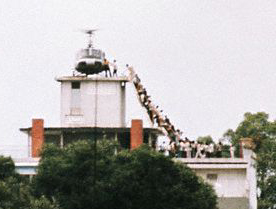
    Vietnamescape
    The Americans bailed, let’s get out of here! (Vietnam 1975? Iraq 20×6?)

    [Note: this article is a reposting of something I wrote for my family-only blog. It seems to be appropriate for general circulation, though, and I now present it with only the slightest editing.]

    I sort of think fighting over politics is like Bible bashing: totally unproductive. Why fight over the Good News? Why start a war talking about a war? With these risks in mind, I do want to throw in a few thoughts of mine.

    Those Who Cannot Remember the Past are Condemned to Repeat It

    It’s important to keep things in perspective. The failure of the Treaty of Versailles after WWI taught the Allies to do things differently after WWII. The debacle of the collapse of South Vietnam after U.S. withdrawal there should teach us to do things differently with Iraq. What happened when the United States pulled out of Vietnam? The Democratic Congress refused to finance further military operations in Vietnam and the south of that country was swept over by the communist forces, hundreds of thousands of people were sent to “re-education” camps as punishment for “collaborating” with the Americans during the war, and Vietnam embarked on a 20 year epoch of isolation from which it has only recently been emerging, at least economically. Vietnam has yet to grant freedoms of religion or speech, and represses those liberties far more rigorously than the Chinese Communists do. (For more information on the withdrawal and the Communist takeover see Operation Frequent Wind and Fall of Saigon in Wikipedia.)

    Contrast that with South Korea, where the U.S. forces did not withdraw. South Korea allows full freedom of expression and religion, and turns out to be the world’s 13th largest economy, ahead of Australia and Russia. More recent data shows that Russian and perhaps Australia have leaped ahead of South Korea in economic output since I originally posted this.)) If American support for the war declined to Vietnam-like levels, we may have withdrawn, subjecting the entire Korean peninsula to the benighted state currently reserved for the pitiable North.

    Comparing the Costs

    Significantly, nearly 60,000 U.S. soldiers died in Vietnam, twenty times the current casualties in Iraq after 2.5 times as many years. Given the current average casualty rate, it will take about 72 more years for casualties in Iraq to equal casualties in Vietnam. Current spending on Iraq is relatively less than in Vietnam as well. (Of course, 1-2% of the GNP of the United States annually is still an astronomical sum.)

    About 100,000 Americans die every year as a result of alcohol use according to some sources. (According to CDC’s more conservative estimates, “excessive alcohol use was responsible for approximately 75,000 preventable deaths” in the United States in 2001.) “The total cost of alcohol problems is $175.9 billion a year (compared to $114.2 billion for other drug problems and $137 billion for smoking).” (Marin Institute) By contrast, the United States is spending about $120 billion a year in Iraq and Afghanistan combined. We could save twice as much money and hundreds of times more lives by eliminating alcohol and tobacco than we would save by withdrawing from Iraq and Afghanistan. What are our priorities? Is this really all about saving lives and money? Or is it about lack of will, unwillingness to stick with a commitment once we’re bored of it? In the Book of Mormon, it’s clear that the problem the Nephites had with the infestation of robbers had more to do with having the will to do what was necessary to eradicate them than it had to do with having sufficient strength to do so or with being morally justified in doing so. (See Helaman 6:18,20-21,37. The robbers of Gadianton described in the Book of Mormon are a stunningly close parallel to Jihadist terrorists, from their organizational structure to their penchant for hiding out in mountainous regions.)

    43% of marriages contracted today will theoretically end in divorce.

    Many war opponents argue that every life is precious, every soldier’s death is a tragedy. True. But at least they are dieing in the hope of helping a nation onto its feet and into a free, prosperous, peaceful future rather than merely in the pursuit of a high or a quick slosh.

    Having mentioned the Book of Mormon already, I’d like to say that that book does seem to condemn the way in which we entered the war in Iraq. Regardless, we’re there, basically the whole nation agreed to go there, and we have a responsibility to leave things better than we found them.

    Post Mortem

    Was that so bad? If nobody else cared to read it, I’m still glad I wrote it. I feel like, given media coverage, people almost have no option but to hate the war, hate the president, and just “want out.” I have too much respect for myself to simply accept what’s handed to me by CNN or even our favorite student paper, The Daily Universe (which mostly just runs Associated Press stories, anyway). I’ve just had these thoughts bouncing around for a long time, so it’s good to get them out.

    There is danger in unquestioningly supporting a war. But there is also danger in merely accepting the bidding of the popular media. Supporting or opposing the war in light of history, costs, benefits, consequences, that’s getting to the core of the issues.

    I conditionally support the war in Iraq and the President. I think the Democratic majority in Congress—while it brings with it some serious annoyances—is good in motivating the Republican leadership to innovate and find more effective solutions. As bad as things are in Iraq, they will get much, much worse if we abandon those people. Genocide? Not a happy thing. I still feel like the lives of our men and women are being sacrificed for something noble and still actually attainable, a dream that President Bush and I still share to a large degree: a peaceful, free, democratic Iraq.

  • BYU Dating Reform: Part 1

    So over at Date Club Prophecies you’€™ll find a pseudo-serious but still thought provoking (in some ways) discussion of dating. Honestly, dating in its present form at Brigham Young University and in the United States in general seems inadequate as a match-making institution and perhaps needs some reenvigorating. Here are some of my thoughts.

    The Dilemma

    For those who are not familiar with the BYU dating scene, we here are rather traditional as far as the responsibilities of guys compared to the responsibilities of girls when it comes to dating. So it’€™s incumbent on a guy to ask out a girl. Only very rarely do the girls take the initiative in asking out a guy, and then it is often (at least by me) interpreted as overly aggressive, a definite sign that she must have the hots for you. Just as guys often interpret a girl asking them on a date as a sign of very significant interest, girls often feel that if a guy asks them out more than once, he must have already made up his mind to marry her and is now “moving in for the kill”€.

    This paranoia is partly founded in BYU’€™s history and reputation as the “marriage capitol of the world:” some who graduate from BYU single would like to get their money back because they thought that a guaranteed marriage proposal was included with the price of tuition. Probably more significant than the effect of elevated expectations, it’€™s likely that the girls’€™ fears of creepy pursuit are based on the collective bad experiences of all modernday BYU women. There are without doubt guys who pursue girls with a singleminded intensity that terrifies their “quarry”€ and for whom a single date seems like sure confirmation that the girl is ready for marriage. I have known guys with this mindset; indeed, I’€™ve to some extent been part of this mindset. Creepy guys in Central Park make everybody in New York afraid of their neighbors. Creepy guys in the BYU dating pool make girls afraid of the rest of us.

    The Most Frightening Possibility

    But casting all of the blame at the feet of “those creepy guys” is avoiding the most frightening possibility: What if it’€™s me? This thought must eventually enter the mind of all but the most dense and egotistical of BYU’€™s despairing bachelors: What if I can’€™t get a girlfriend—can’€™t even get a girl to go on more than one date with me without getting creeped out—because I’€™m just not cool enough? What if I just don’t have what it takes to compete in the cut-throat competition for a chica? Oooh, what a dark and hideous thought that one is!

    The notion lie that somebody is simply not “cool enough”€ is total garbage. That idea assumes that the likelihood of the desired result (getting a girlfriend) is a function of the “coolness” (whatever that means) of the guy seeking it. This is true for those whose entire existence revolves around external form and superficiality rather than quality of character and spirit. But for the rest of us… well, there are patterns. More energetic, flirtacious people probably have an easier time getting into relationships because they’€™re capable of attracting more positive attention at themselves. But overall—I like to tell myself—there are more important factors, especially when you consider not just “hooking up,” but doing so with somebody that you really respect and admire, who’€™s more than merely an attractive figure.

    What are these factors and how do you employ them to your advantage? Stay tuned for Part 2 of BYU Dating Reform where we’€™ll consider Five Totally Speculative Non-Guaranteed Steps to Getting Your First Girlfriend.