Blog

  • Performancing – What’s the License?

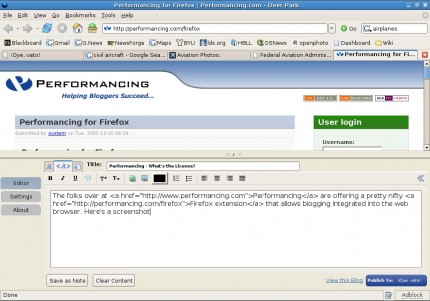
    The folks over at Performancing are offering a pretty nifty Firefox extension that allows blogging integrated into the web browser. Here’s a screenshot:

    performancing

    But what license is it released under? Is it open source so I won’t have to worry about it suddenly not being free anymore? If anybody knows, drop me a line.

  • Wikipedia: no muy autoritario

    So, there’s all kinds of stink lately as a result of Wikipedia‘s defamatory information debacle. Today, I got back a paper back in my Spanish Literature class. In that paper, I cited Wikipedia’€™s Spanish language article on the Ultraism movement in Spain in the early 20th Century. I also cited Wikipedia for some information on Jorge Luis Borges. My profesor wrote a comment referring to Wikipedia on my works cited page: “Cuidado con esta enciclopedia que es de entregas voluntarias. No es muy autoritaria.” (Caution with this encyclopedia, which is from voluntary submissions. It isn’€™t very authoritative). Of course, I know that already, but when you’re pressed for time it’€™s often the most convenient source. So my question is not, Should I find different sources? My answer to that is already “yes”€; if I’€™m doing a research paper I’€™m never going to cite Wikipedia! (This paper was just a literary analysis.) My real question is, What can we do to make Wikipedia – or some similar project – factually reliable?

    Over at j’€™s scratchpad, a blog by a news librarian over at Harvard, there is some convincing evidence that the majority of edits on Wikipedia come from registered users. The latest incremental reform attempting to make Wikipedia more dependable [is ???]. But that’€™s not enough. It doesn’t prevent the sort of defamatory comments that have gotten Wikipedia into trouble lately. Here are a few thoughts on what would be enough:

    1. Create a fact-checking review team. These would be registered users charged with checking the validity of articles. These users would rate each other based on the accuracy of articles that have passed their inspection. Every article would show in a prominent location its fact-check rating, which is essentially a rating of the people who have reviewed the article. Because articles are frequently revised, readers would have the option of viewing a “€œcertified version”, the version that the reviewers have approved. We do have to consider that Wikipedia sees 15,000 new articles a month. Odds are the fact-checkers would never in the near future get close to covering the entire encyclopedia, but it might lend additional credibility to the articles that are checked.
      Eventually, Wikipedia’€™s growth and modification rate may decrease as its topic coverage and article quality mature. This might allow the fact-checking teams to eventually cover a large proporcion of the articles.

    2. Require an extensive bibliography for any article before it can be “certified” by the fact-checkers. Some articles currently include decent bibliographies, but many more do not. Additionally, there is little guarantee that the bibliographies are not simply padded. What I want to see is not just general bibliography entries, but specific citations. That means page numbers and text within quotes. That means some sort of a system of footnotes or in-line citations. This way, an article would be verifiable.
      I’€™m fortunate enough to have BYU’s Harold B. Lee Library just up the hill from me, but not everybody has access to such a research library. I imagine that there are a sufficient number of university students involved with Wikipedia that this isn’t an entirely unreasonable requirement. We have already discussed the point of the percentage of articles that can receive such detailed attention in #1.

    I’€™m more or less a fan of the general idea of Wikipedia. A combination of these two and perhaps other “reforms” could improve the quality and reliability of Wikipedia without throwing out the speedy, wide-ranging coverage that its open editability provides.
    Comments? Contradictions? It’€™s a very interesting debate.

  • Amigote: a blog identity crisis!

    Ok, I’ve begun the process of developing my own theme for this blog. Its ancestry goes directly to the c3ro theme, and basically it is exactly the same… for now! The name of my version of the theme is “Amigote” which as we all know is Spanish for “big jerk friend” (approx. translation). I figured, Hey, the name of my site is ¡Oye, vato! for as-yet unexplained reasons, so why not make the name of the theme be “amigote” for similarly unexplained reasons?

    Which leads me to a much needed digression: it’s time that “we” here at ¡Oye, vato! suffer our first blog identity crisis! Everybody cheer!

    The first problems are, What the heck does ¡Oye, vato! mean? and ¿do you always have to write the upside down exclamation point? From the lovely website Pachuquismos we get this definition of “vato”:

    Vato: Used instead of “homeboy”, “dude”, etc.

    So pretty much this blog could be retitled en inglés, “Hey, Dude!” Except that’s not nearly as cool and was the name of a ridiculous TV show on Nickelodeon a million years ago (does anybody else remember that?)

    Moving on (without addressing the exclamation point issue)…. “We” “staff member(s)” here at ¡Oye, vato! are realistic about the amount of exposure our astoundingly insightful commentary on world events and the state of software receives; so far, we know of one semi-regular visitor: The Shark. You know, the fellow who brought you such moving posts as Russian squirrel pack “kills dog” and… Anyway, “the editorial board” here, while grateful for the consistent high quality of The Shark’s contributions to the ¡Oye, vato! community, acknowledges that a greater diversity of worldviews and a greater number of eyes looking for psycho news stories are both in order. For this purpose, we are now listed with Technorati in an effort to increase The Vato’s sphere of influence.

    So, as we wrap up this identity crisis, let’s review:

    1. always refer to the first person singular using the first person plural

    And that’s pretty much it. Thanks for tuning in, and sorry if the sarcasm was a bit too thick. Good night!