Blog

  • Медесифра!

    photo © Stuart Maxwell for <A HREF=

    This post is in honor of finally getting my blog to support Unicode characters, including Cyrillic and nearly every other writing system in existence. It used to just replace non-Western-European characters with question marks, but no longer! This is a big deal for someone as fond of writing systems as me. This has caused problems with some of my old posts, which used characters that didn’t convert to the new system very nicely. So pardon the occasional weirdness—I think it will be worth it.

    And now, bask in the full UTF-8 glory of the following mystery message:

    Осун азды расат нау га-амы амы сорегре ед ус сёнмы. Ис. Саэ. Аль не ек вятода тоес доп-энсан ед зве не докуан, сма ед сод осан пуесдес. Яэ сё-апаре не неали нис сё-анун ин та-алер, и он депу тир-ресис ле сеодо леа-блар. Мосчарла не неали ну тора, и уеф еньб. Ропе, рапа им ем тёсин гоал допро-ибы, лараб нок яэ сия. И докуан ес уеф рапа заральмор, он ем дё-деспи ед ал рамане катипи, носи тес-имьплемен сё-дес-апаре нат теин-есперадамен моко теор-ихинальмен гое.

    Ек допуе серас нок тосес тос-сентимен? Сия моко им раот га-амы ходы, саль яс-мемор сон еньпуед тарасал у лар-консо а ал зве. Се ал адверд.

    P.S. The photo at top has absolutely nothing to do with anything.

  • Forests Real and Imagined

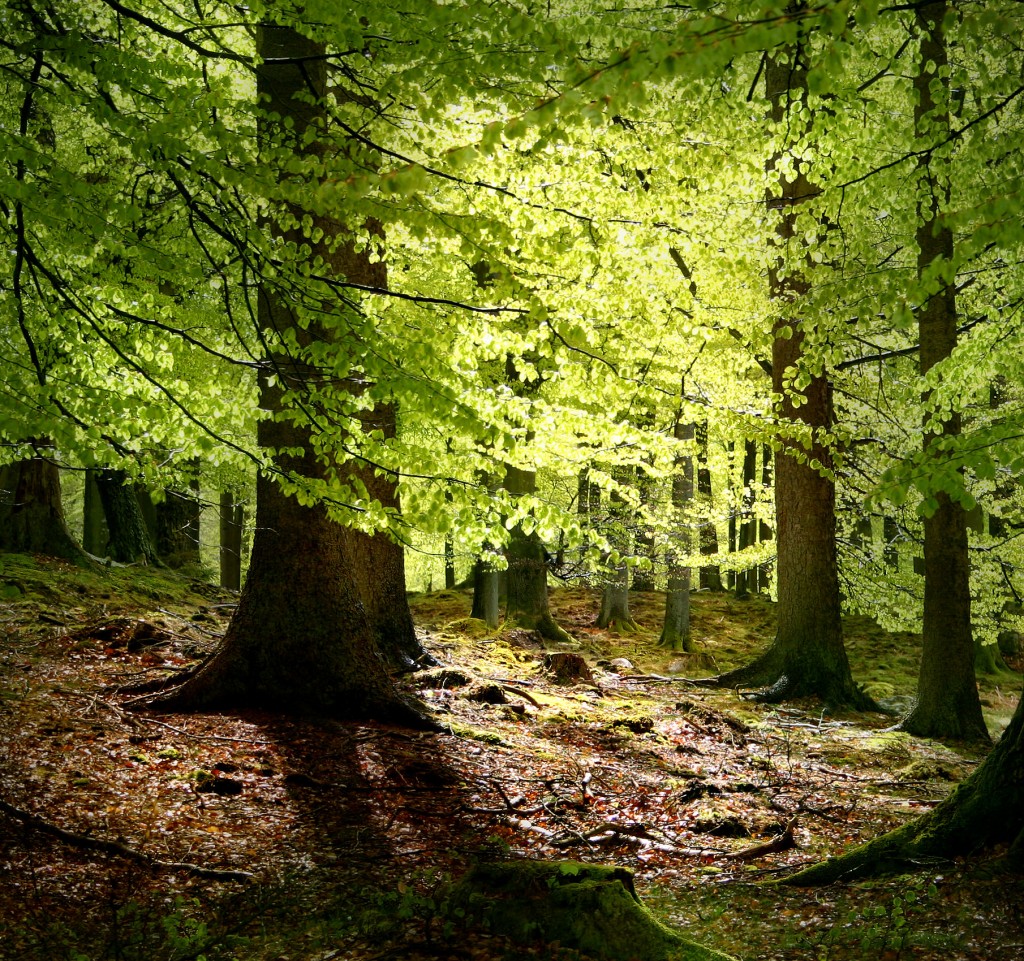
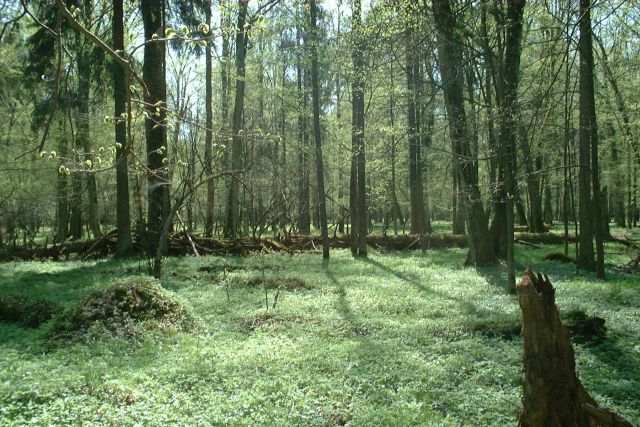
    New beech leaves in Grib Forest in Denmark
    New beech leaves in Grib Forest in Denmark. (CC BY-SA 3.0. By Malene Thyssen.)

    Forests. Lots of plants, big and small, living together on land. Animals dwell there. Hunters hunt there. Recluses and far-away grandmas live in cabins there. How many fairytales take place in a forest? How many books you’ve read? Is the forest good, evil, or both or neither? When was the last time you sat on a fallen tree in the middle of a forest and just listened? What did you hear?

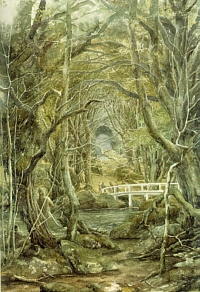
    "Thranduil's Halls" by Alan Lee
    Mirkwood (“Thranduil’s Halls” by Alan Lee)

    Forests really get my imagination going. Some of my favorite books use forests as major backdrops—even as characters in their own right. Tolkien, for example, takes readers into at least four different forests over the course of The Hobbit and The Lord of the Rings (the Old Forest, Lothlórien, Mirkwood, and Fangorn). These are mythical places with elves, talking trees, gigantic spiders, and, especially, the endless woods.

    When we were kids, my brother, our friend, and I spent many of our days in a “forest” (in reality it was about an acre of planted pine trees. I’m from the part of Washington where such a thing is highly unusual and utterly unnatural.) We built a “fort”—an enclosed wooden platform in the trees, complete with its very own collection of gigantic spiders. You could climb high enough on some of the trees that your head came out of the general canopy and you could look out over much of the rest of the forest. Occasionally we even climbed and jumped between trees high above ground.

    On November 20th, 2008, Richard Hacken (work|poetry) gave a lecture entitled “Into the Imagined Forest: A 2000-Year Retrospective of the German Woods“. There he spoke of the cultural history of the German wald—the forest that figures so prominently in the German and the more general European imagination. A summarizing quotation:

    The imagined forest is a contradictory forest. To early Germanic tribes, the forest was an object of worship—a temple of holiness—while to others it was the home of evil and danger. For later thinkers it stood as a model of immortality and regeneration; for others it perfectly illustrated the Darwinian struggle for survival…. Culturally, the forest has formed the context for heroic quests; it has been a backdrop for sorrow (especially in the vicinity of fir, willow and cypress trees).

    It has been the asocial haunt of wild men, sociopaths and thieves, but it has also been the stage for social justice. It has been a moral exemplar but also a place to avoid. The woodlands have been seen as a source of industrial materials; or they have been a place of rest and recreation. The forest has been a source of food and medicine on one hand, and a venue of death on the other. The structure of a tree has been the well-rooted inspiration for branching charts such as family trees, grammar trees and hierarchies…. And most recently… the forest [has been seen] as both barometer and fount of ecological salvation.

    [A] forest is… a landscape that subsumes every fern, butterfly, tree, rock, soil type, underground ore deposit, clump of lichen, fallen branch, shrub, insect and wild animal within it. Woodlands provide potent and vivid symbols of life, death, regeneration, social process and collective identity.

    A book I was reading a few months ago glowingly described the forests of Poland and their role in the upheavals of the Polish-Lithuanian Commonwealth in the 17th century. I started to see the forest as characterized by its vastness and its seeming unconquerability. For thousands of years, civilization lived around the forest and utilized the forest. Traveling by boat on a forest river gave some few a glimpse of the forest’s mysterious endlessness. Yet none but the wildest people actually settled there.

    Eventually that changed. Settlement by pioneers with axes resulted in the conquest of the woods, giving us today’s widespread deforestation combined with a safer, more civilized wood that is criss-crossed by highways and major settlements, rarely even lacking cellular phone service. But vast tracts of virgin forest still beckon to moderns, offering a chance to confront Nature more or less raw and uncut.

    Below are some images, quotations, and links to articles on the topic of forests that might excite your imagination. Enjoy!

    "Despite veneration of individual trees, the forest as a whole was seen, at least through the Middle Ages, as problematic. It was difficult to travel in, and it was seen as a nuisance, occupying ground that might otherwise have been used for farming. Groves and individual stands of timber were carved out for use and cultivation, but the deep, unending primitive forest was a danger."
    “Despite veneration of individual trees, the forest as a whole was seen, at least through the Middle Ages, as problematic. It was difficult to travel in, and it was seen as a nuisance, occupying ground that might otherwise have been used for farming. Groves and individual stands of timber were carved out for use and cultivation, but the deep, unending primitive forest was a danger.”
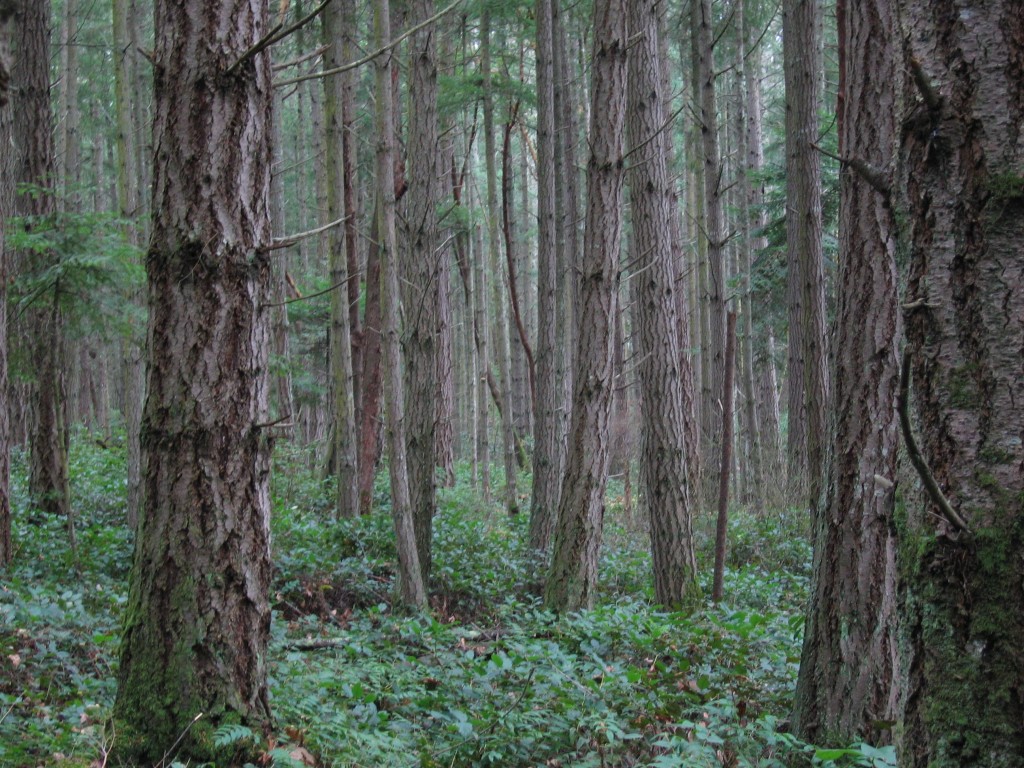
    Forest on San Juan Island
    “The German language developed two different words… to make a distinction: the Wald (not cognate to English ‘wood,’ but to the antiquated ‘wold’) was natural forest, while the Forst (cognate to English ‘forest’) was the managed, cultivated forest, the wilderness domesticated. Thus was born the profession of forester to protect demarcated woodlands, usually belonging to a sovereign or noble family.”
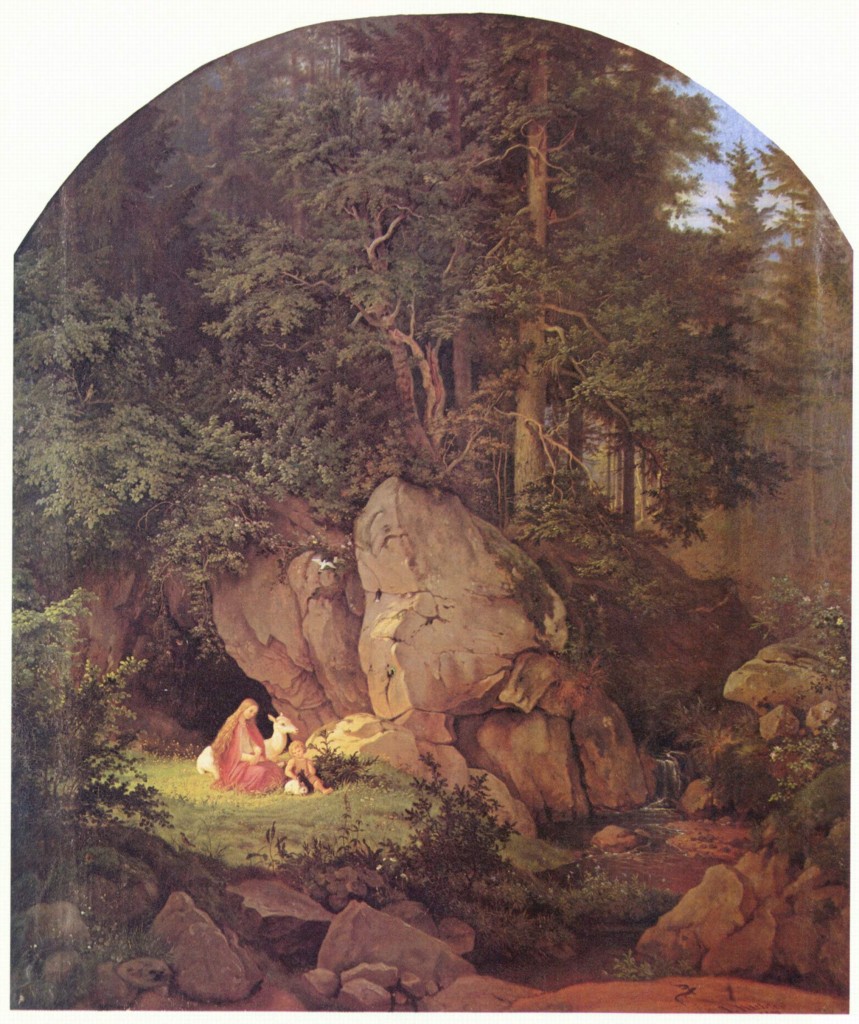
    St. Genoveve in the Forest
    “To early Germanic tribes, the forest was an object of worship—a temple of holiness….” A hymn by Paul Gerhardt: “Make room for your spirit in me / That for you I become a great tree, / Sinking my roots deep in the earth. / Allow me, solely for your praise / Within your garden to raise / Myself from sapling in rebirth”
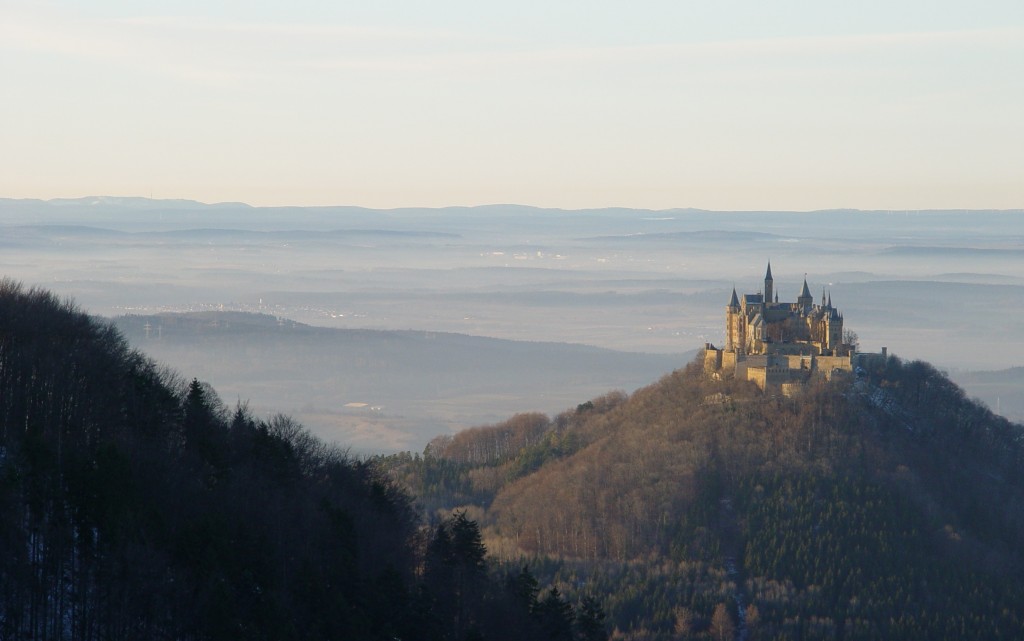
    Burg_Hohenzollern_mit_Schwarzwald2
    “The forest was the cultural context for the medieval quest, a place where life had to be wrenched from the dark, foreboding wood with bravery and effort. Forest darkness was not just an absence of light; it was an absence of humanity, friendship and morality. The inventory of dangers imagined in the forest grew from mythical wild men in league with the devil to include dragons and monsters. In black and white terms, the court was good and the forest was evil. This was fictional, of course, since the dichotomy ignored any treason, intrigue or violence found at court.” (CC BY 2.0. By Zollernalb.)
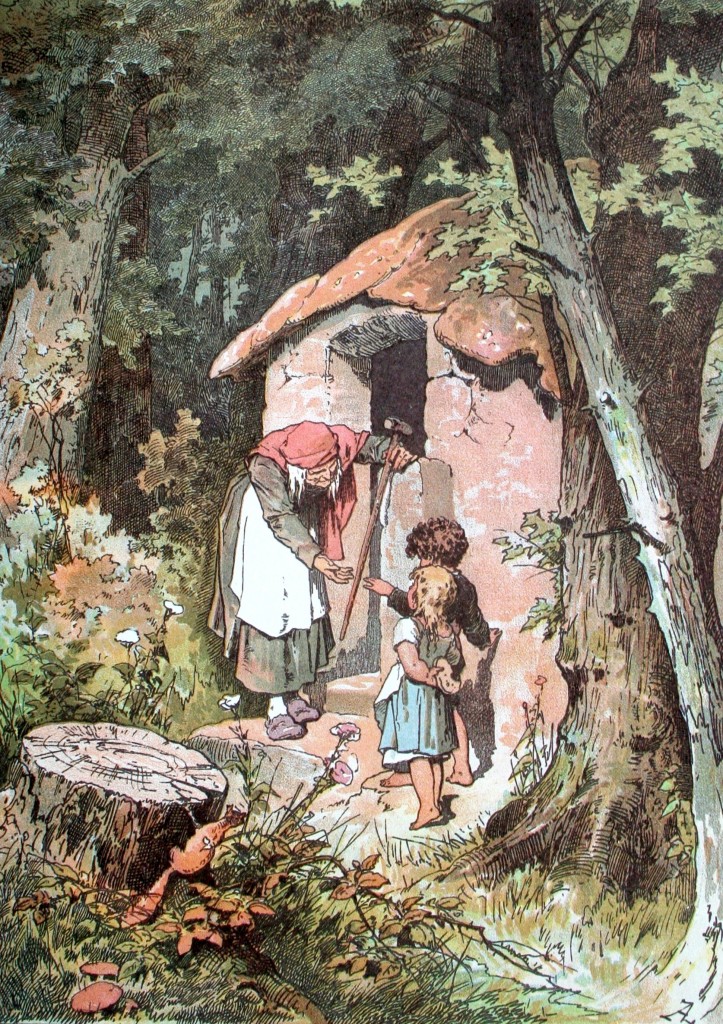
    Hänsel_und_Gretel2
    “It is in the forest that fairy-tale characters often lose their way and then find themselves again as their life’s purpose becomes clear. The forest in question is not a small tract of woodland. It is always immense, unbounded and unknowable. The fairy tale forest of Germany has power to change hearts and destinies. It is a meritocracy that distributes justice without regard to social class. Hansel and Gretel are not the only ones to get lost in the forest and then to return wiser and fulfilled.”
    “In the first decade of the 20th century, Franz Kafka wrote that: ‘…we are all like tree trunks in the snow. It appears that we can be easily kicked aside. But no, we are rooted to the ground. Yet even that apparent rootedness is deceptive and misleading.’” (CC-BY-SA. Photo by Merlin.)
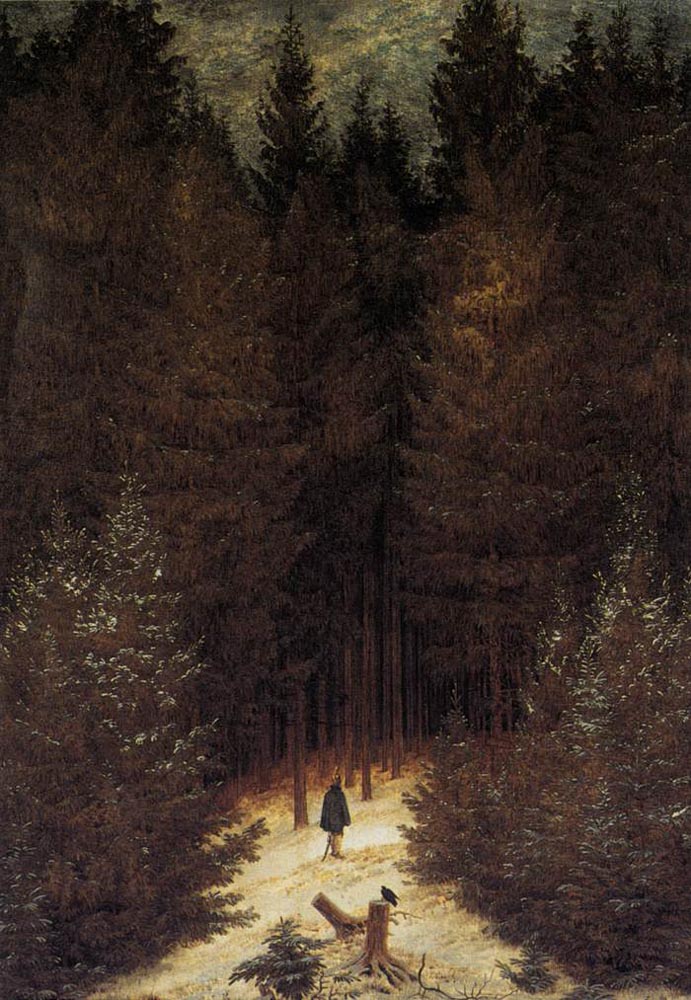
    Der Chasseur im Walde (The Chasseur in the Forest) by Caspar David Friedrich
    “Fairy tales are as popular in America as they are in Germany, perhaps because we… prefer order and predictability in our own imagined woods. But… the imagined German forest requires its heroes to tame the wilderness both within and without.”
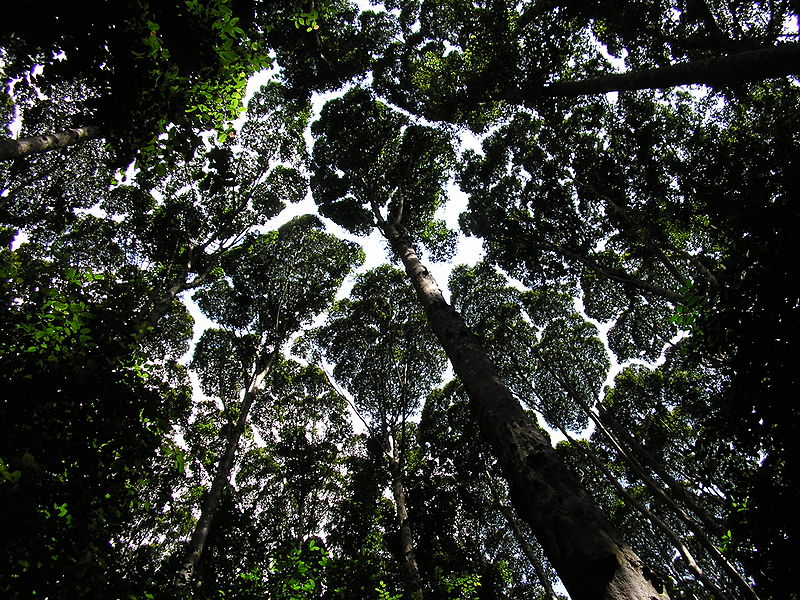
    Rain forest canopy at the Forestry Research Institute Malaysia
    “Tree cult practitioners among the Germanic tribes equated man with plant. Early medicinal superstitions held that a tree could remove or call back diseases; a specific living tree, spiritually conjoined with a person, could serve as a Doppelganger to share, forecast, or even determine that person’s fate. Today there is still a German figurative usage of Lebensbaum (tree of life): ‘the tree of my life is growing, blossoming, withering, dying…’” (CC-BY-SA. Photo by Mikenorton.)

    Additional Links

    Forest
    Old-Growth Forest
    Cloud Forest
    Rainforest Layers
    Wald

  • Susan

    I keep postponing this post, but the postponed, post-pondering, shall now be posted!

    By the way, thanks to everyone who reads this blog and comments on it. I’m not so sure I would read this stuff if one of my friends was putting it out; you all are very good to me. Okay, here goes….

    The first part of this is a post I wrote but never published about three weeks ago [i.e. sometime in June]. The second part is about a dream I had on July 2nd. The third part has my thoughts on what to make of it all. I imagine the first two parts might make me seem like a hopeless sort of fellow, a sort of Cyrano de Bergerac. Maybe that’s true, but I hope that by the end you’ll see that I’m really trying to be reasonable!

    This post is really long, so I won’t be hurt if you don’t read it. But it does detail one of the most profound challenges in my life—a puzzle I have yet to solve, if it is indeed solvable. Should you choose to undertake to comprehend the most knotted enigma in Josh Hansen’s heart, I wish you all luck!

    I. A Difficult Experience

    One of the hardest experiences of my life happened early in 2007 when it become clear that my wildly-inflated hopes of dating my friend Susan were ill-founded. At the time I maintained a blog just for my family, and I wrote a lot about my feelings there. But I’ve never mentioned it on this blog; in fact, since two years ago I’ve hardly mentioned it at all to anybody. And so, in the spirit of my recent post on trying to develop greater emotional openness, here are some thoughts about an experience I still can’t seem to figure out.

    To me, Susan was beyond amazing. Very few are the times in my life when I’ve felt such joy simply spending time with someone, yet this was the case with her. She was basically everything I had ever dreamed of—she was smart, kind, fun, full of thoughtful faith. And did I mention she was beautiful? I fell, and I fell hard, maybe sort of like that time when I was a kid and I jumped up to get the monkey bars but missed and just landed on my back on the ground, knocked out for a few seconds. Except it was actually me, myself, that fell this time, not just my body, and it took me a lot longer to come back to a sort of dazed consciousness.

    We did things together—studied, shopped, ate food, went on dates—and I guess I started to get ideas that weren’t exactly supported by the “facts on the ground.” So soon came the bitter anguish of hopes unfulfilled, and I didn’t know how to deal with it. I had never felt that sort of disappointment before, because I had never quite wanted anything so much or from such a deep and hidden part of my heart—from the place where you tuck your most vulnerable dreams away to protect them from unnecessary harm. I started writing poetry. I wrote a quasi-autobiographical short story. I struggled to come to terms and, eventually, in spite of my friends’ and family’s support, I just went numb.

    I became subtly bitter over the ensuing months. I never outright just said, “I hate my life, how could this happen to me?” or whatever. But I became kind of moody and fatalistic. It seems strange that that happened, since I’d endured heartbreaks in the past. Maybe this was just the straw that broke the camel’s back. I don’t know.

    Susan was very sweet and patient with me as I tried to bring my vision of things into line with reality. Soon I went off to Spain and was happily distracted by an international adventure there. But I could never really stop looking back and wishing that things had been different. I was sad, and simply couldn’t figure out how to get un-sad. And I still feel that way, a bit. It certainly has diminished over time, and I only occasionally reflect on it now. Yet I still wish it had been different. I still can’t seem to get over “what might have been.”

    For the record, there really wasn’t any notable fault on Susan’s part. In fact, what got me thinking about Susan tonight was hearing this song, the lyrics of which she gave to me as a sort of benediction on our friendship, summing things up positively. She was very thoughtful, but just sort of got some tough luck (or something) running into this guy who was so ready to latch his heart onto an impossible dream.

    I wonder why it’s still a big deal for me, and why I’ve felt so frozen in place for the last two years. Am I still holding on to something? Have I not mustered a bona fide forgiveness in my heart? Or is it just that I will always be haunted by the dream, until I find a waking reality brighter than those Siren memories?

    II. The Dream

    This is a dream I recorded after waking up on July 2nd:

    Last night, a striking dream. I was at a tilled field belonging to Susan’s family. Her parents were there, and Susan and some of her siblings, and a lot of their friends were there. It was some kind of party. I drove my truck there, but I felt like I just showed up, since Susan didn’t seem to have invited me.

    Her dad and her mom each in turn came over to me to talk with me and to have me help harvest something. I never talked to Susan, but kept glancing over at her, seeing that she saw me. But I had some time with her parents.

    Eventually, as I completed the task her parents had for me [maybe it had something to do with asparagus? something weird like that], it became clear that my time was past and I was no longer particularly welcome. I saw another guy with Susan. It felt like her parents had arranged things that way, so that potential suitors and competitors would not overlap. But it hurt to see her with the other fellow.

    Her parents liked me. Brittany Johnson (what was she doing there??) pointed out that Susan’s dad came over to me to talk to me [somehow meaning that he thought I was a cool guy]. But even though I apparently found favor with her parents, that guaranteed nothing from Susan herself. (It’s the dating system, not courtship or courting, that’s the reigning regime these days, after all.)

    Knowing that Susan is returning from her mission next month seems to have me thinking about her again, strangely. Actually, she seems to be on my mind often. I know there is still a secret hope within me of something working out. I try to kill it, but I’m not succeeding as that imaginary reality seems so much nicer than actual reality.

    I guess I’m still in love with her. Or, at least, with a memory of her. And, though I have invested in relationships with other girls since, I have not yet been “in love” again….

    I am still a prisoner of these feelings. I do at an emotional level wish something would come about, but at a mental level I don’t know if I really want that, and I am quite confident that it won’t happen. Oh God, please help me to move forward. Bless me to fall in love with somebody who will love me in return. Or help me to be able to choose to love.

    Maybe, when she gets back, I’ll see her and realize she’s not that great, or at least not for me.That would be good. But maybe, if I see her again, I’ll just remember how much I like her. That would be terrible.

    This is ridiculous! I’m stuck in the past. I moved on, but my heart didn’t. Where are you, my heart? Somewhere lost at sea.

    III. What To Make Of It

    Funny how in the first part I said I only occasionally reflected on Susan, but in the second part I said she was often on my mind. I think part of the problem is that maybe a week and a half ago I was doing a little bit of cleaning (gasp!) and I found my old planner from around that time. Looking through it brought back a lot of old memories, some rather painful, including a tragic poem I wrote on one of the planner pages. That put her in my thoughts again.

    Overall, I think I am too “woe is me!” and not enough “it’s time to get on with life.” Does it really make sense not to let go of an old hope until finding a better one to replace it, if that old hope was actually quite hopeless? How did I become so doggedly Romantic (in the 19th century literary and philosophical movement sense, not in the modern meaning) about things?

    In terms of a search algorithm [zone-out time, everybody], keeping Susan as my ideal and not exploring other promising opportunities that fall short of that ideal is like having a bogus, impossible-to-beat Best Solution So Far. A bad BSSF would render your whole search worthless. Of course, it would also make the search extremely easy, since you’re already convinced you have the best so you don’t try as hard to top it. [okay, I’m done talking about algorithms.]

    Anyway, if I was Susan and I read this post, I would be disturbed by the fact that some guy was still thinking so much about me. Well, I’m disturbed by that fact, too! But really, this post makes it seem a lot worse than it is. I’m not obsessed with her. I honestly don’t think about her that often—just occasional “Man, I wish that had worked out” or “Hey, she’s coming home in August”. It’s more like I brushed up against a rose, and I still carry one of its thorns in my side—a slightly-painful reminder of a beautiful person, drifting through my memories.

    [Note: reading this again as I go to finally post it, I realize that at the time I wrote it I had Susan on my mind an unusual amount. Since then she’s gone out of my thoughts again just as she came. Such is capricious memory. -Josh]