Category: politics

  • Immigration’s Economic Key

    Problems With the Romney Plan

    Mitt Romney’s plan to end illegal immigration worries me. In particular, this point bodes ill for the economy:

    Encourage Legal Immigration. Streamline the system to recruit and retain skilled workers and welcome the best and the brightest from around the world to our universities.

    To begin with, we already get “the best and brightest from around the world” in our universities. Some countries suffer from substantial “brain drain” that largely goes to the United States. Also, I support the idea of making the legal immigration system work. The big question is, Who decides how many people from where get to come?

    But the real problem I see here is two-fold. First, it is not only skilled but also unskilled labor that is in demand. Second, who decides what makes somebody skilled? Which skills are useful? The freewheeling illegal immigration that has been occurring lets the market determine the answer to that. Any other system is likely to suffer from attempts at micromanaging the economy—a sort of outward-looking central planning system. Think of it as the Soviet Union take on immigration. Great.

    Key Economics

    The crux of the matter is the ability of illegal workers to undercut citizens/nationals by working for less than minimum wage. If we remove this ability by tighter border enforcement, active prosecution of employers who pay unlawfully low wages, and easier legal entry to help document and track those who come in to the country, then I believe we would have the following results:

    1. Lower-class citizens/nationals would be better able to compete for jobs in the lowest wage range.
    2. Increased prices of consumer goods due to higher labor costs for employers.
    3. Decreased employment overall, but, at least initially, a higher proportion of those employed will be citizens/nationals, and those employed will be paid at least minimum wage.

    If we as a nation decide that that is a desirable combination of outcomes, then let’s do it.
  • ‘Bourne Ultimatum’ and the Rule of Law in a Republic

    Just watched The Bourne Ultimatum with my sister and my bro-in-law. Cool movie, very well done! Of course, amidst the excellent action, its philosophical point wasn’t wasted on me. I don’t know if the original book was really about this, but it was a timely statement on the tension between security and liberty.

    A Tale of Two Extremisms

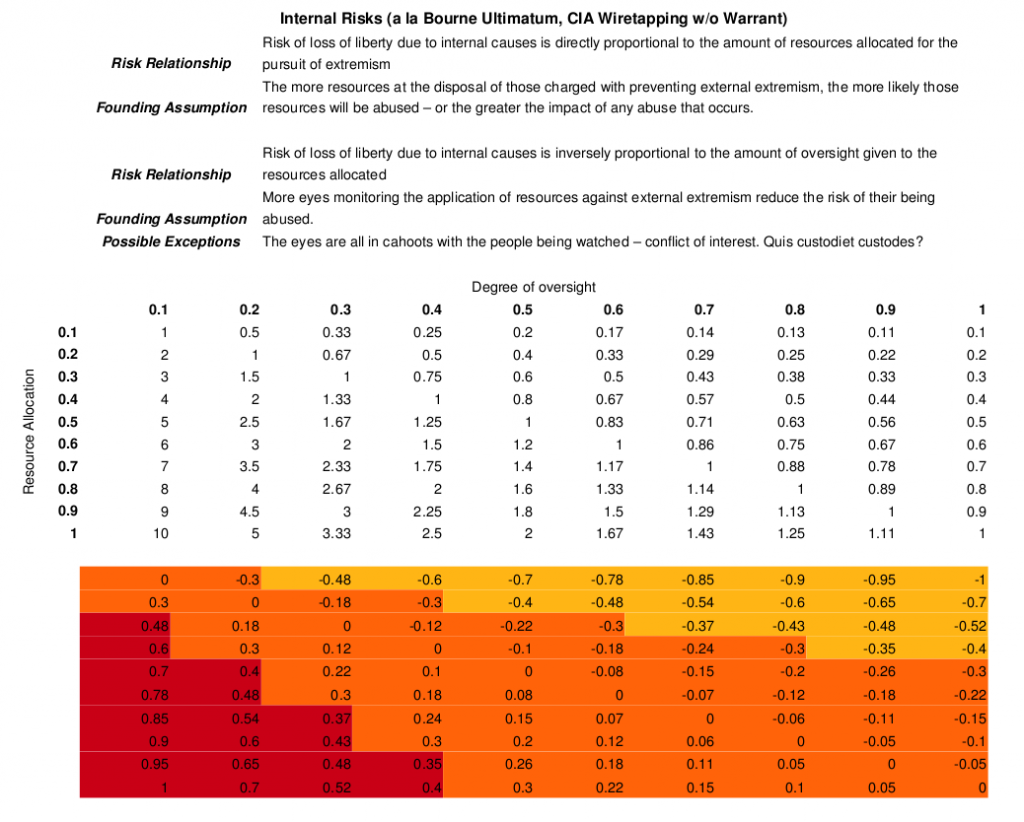
    One of the great challenges of our time is the defense of liberty against extremist threats, while balancing abuses resulting from too many resources and too little oversight in the instruments created or adapted for that fight. Or rather, the challenge is to defend liberty against multiple threats, multiple extremisms:

    1. extremism abroad (external risk) such as radical Islam that seeks to destroy our precious free institutions by means of terrorism and other subversive methods
    2. extremism at home (internal risk) in the form of overzealousness in battling the first form of extremism.

    The Nature of the Evils of Internal and External Risks to Liberty

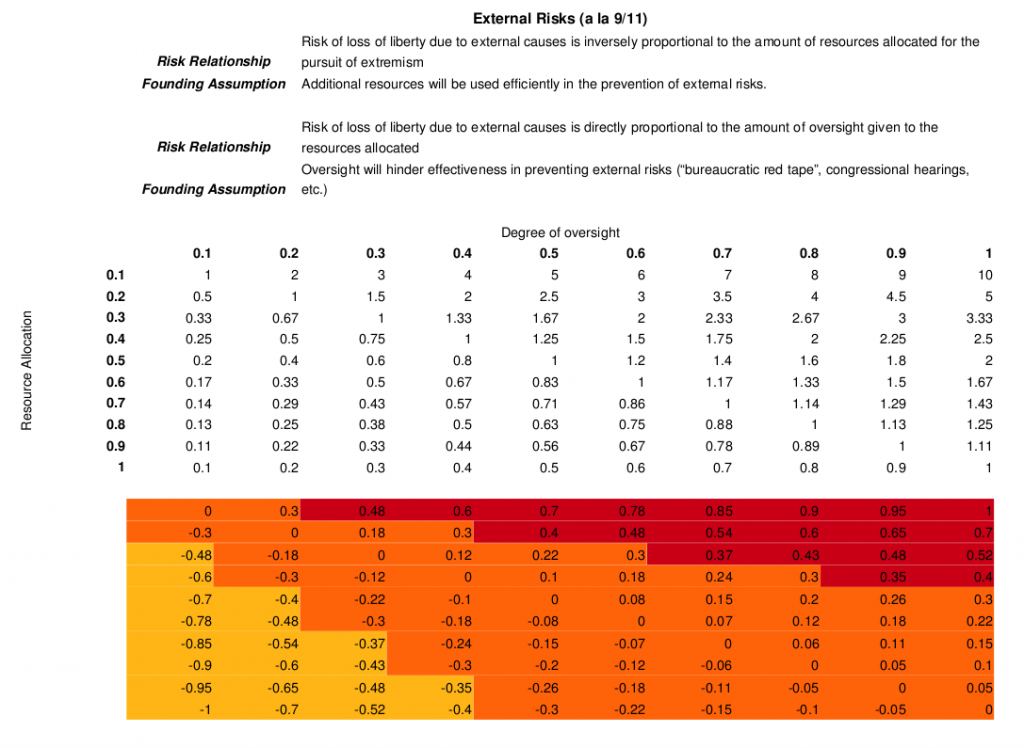
    A useful assertion to make and then analyze is that likelihood or severity of external risks to liberty is inversely proportional to the amount of resources employed in their prevention and directly proportional to the amount of oversight committed to this resources. External risks are greatest when oversight is burdensome and resources are inadequate:

    external riskLikewise, the likelihood or severity of internal risks to liberty could be said to be directly proportional to the quantity of resources employed in prevention of external risks, and inversely proportional to the degree of oversight committed to those resources. Internal risks are greatest when too many resources are in the hands of people whose activities are insufficiently monitored:

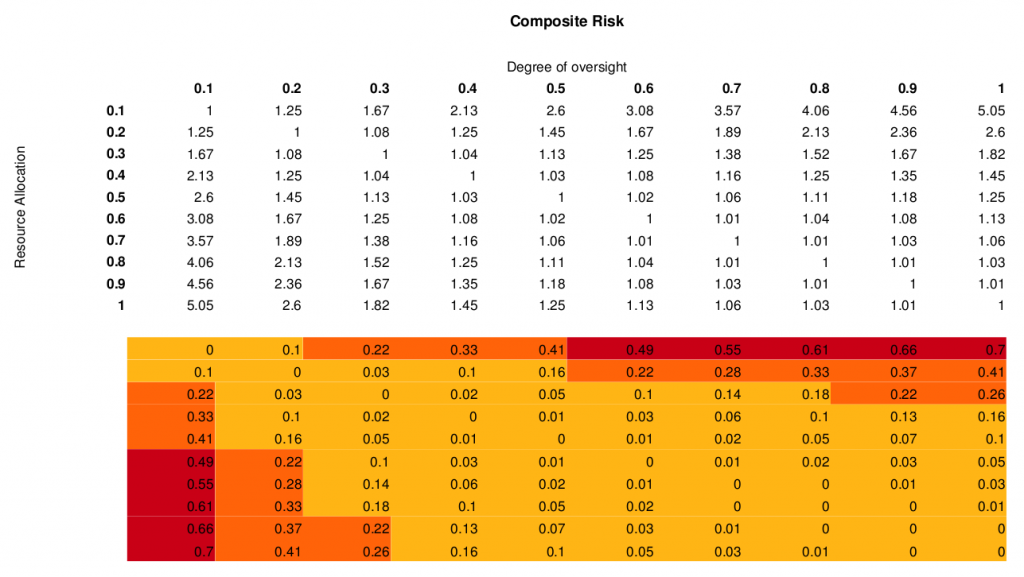
    internal riskInternal and external risks can be combined to create a hybrid pseudo-metric:

    composite riskThe obvious story of this chart is that too great of an imbalance of resources or oversight in either direction creates a risk that liberties will be lost. (Note that in all of these charts, the colored section is equal to the log of the corresponding value in the non-colored scale. This was to make it easy to apply a color scheme.)

    Summary

    I’m in favor of normalizing the civil liberties regime during this conflict against external extremism. That means no holding of prisoners without trials. The key reason this is critical now when it wasn’t necessarily so during the civil war, for example, is that terrorism will never go away. If we let it, it will become the perpetual wars from 1984 or the state of emergency of Caesar and Emperor Palpatine alike: a constant justification for shafting liberty.

    We clearly can’t abandon intelligence-gathering efforts. These must be effective. But at the moment our oversight of those efforts is probably too low. We need to devise a system by which a significant number of eyes outside of the intelligence community knows what those folks are up to and has a reasonable means of lodging complaints against abuses.

    Quis custodiet ipsos custodes?

  • Faith in America

    I just watched Mitt Romney’s speech on “Faith in America” and was quite impressed. I was impressed how he framed his ideas in terms of the moral foundation of the Declaration of Independence—much as Lincoln framed his arguments against slavery not in any formalism in the Constitution, but on the Declaration. I was impressed by his bold declaration of belief in his Mormon faith, and his unwillingness to reduce that faith to mere “tradition.” I was impressed by his articulation of religion as a dynamic force in American public life, his interpretation of constitutionally-established religious freedom as neither a religion of secularism nor an endorsement of any one particular religion. He did this in a manner much clearer and more inspiring than I’ve ever seen before. While I remain decidedly undecided as far as which candidate to support for president next year, I will certainly consider this.