Category: politics

  • Obamanymy

    One of the great things about the impending presidency of Barack Hussein Obama is that his name is awesome. I guess that’s what you get when your last name begins with an open syllable (meaning that it starts with a vowel). I predict that a whole new subfield of onomastics dedicated to the study of Barack Obama’s name will arise. This will be called obamanymy: the study of names derived from Obama.

    Obamanymy

    Of course, the opposition started it out with their [idiotic] chant of “Nobama,” but there are so many more possibilities! For example, here are a few fun variations:

    • D’ohbama (When you do something stupid)
    • Foebama (When the president is your enemy)
    • Gobama! (Cheering him on)
    • Growbama (He helps the economy!)
    • Hobama (When being a hobo)
    • Jobama (Jomama just got superseded)
    • Lobama (When he’s being highly cerebral)
    • Mobama (When you just can’t get enough)
    • Quobama (Doin’ a little quid pro quo)
    • Roebama (When he’s talking abortion)
    • Sobama (That’s how you start a conversation with the president. Sobama, I was thinkin’….)
    • Snowbama (Winter in D.C.)
    • Throwbama (WWE wrestling move)
    • Toebama (When he toes the party line)
    • Towbama (When his car breaks down)
    • Whoabama (When he’s just too cool)
    • XOXObama (Hugs ‘n’ kisses at the end of a presidential directive)
    • Yobama! (To get his attention)

    In fact, these seem to be the only presidents who had a name that started with a vowel that wasn’t commonly abbreviated (unlike James A. Garfield) or omitted: John Adams, John Quincy Adams, Abraham Lincoln, Andrew Johnson, Chester A. Arthur, Barack Obama. (Ulysses S. Grant’s name begins orthographically with a vowel, but phonologically with a consonant.) Some of those would arguably be more fun than others.

    Obama also ends with an open syllable, facilitating creation of new words. In fact, I’ve already done this several times, including obamanist and obamanymy. But obamanyms aren’t the only examples of this phenomenon. In fact, a larger number of presidents have had names that end with an open syllable: James Monroe, John Quincy Adams, Andrew Jackson, William Henry Harrison, Zachary Taylor, William McKinley, Woodrow Wilson, John F. Kennedy, Jimmy Carter, George W. [Double-u or Dubya] Bush, Barack Obama. But at least to me nothing quite seems to roll off the tongue and meld with prefixes, suffixes, and compounds and overall lend itself to neologicization like the name of Barack Obama.

    Etymology of Obama’s Names

    Barack == Barak: Arabic meaning “blessing”

    Hussein == Husayn == diminuitive of Hasan: Means “handsome”, derived from Arabic hasuna “to be beautiful, to be good”. Hasan was the son of Ali and the grandson of the Prophet Muhammad. He was poisoned by one of his wives and is regarded as a martyr by Shiite Muslims.

    Obama: From a rare [Kenyan] Luo given name, based on a word meaning “crooked” or “slightly bent”. It was possibly originally given to a baby who had an arm or leg that looked slightly bent immediately after birth. It could also possibly have been given to a child who was born in the breech position.

    So, to sum it up, President-Elect Obama’s name augurs a time of good, beautiful, but perhaps crooked or slightly bent blessing for our country. That doesn’t sound too bad 😉
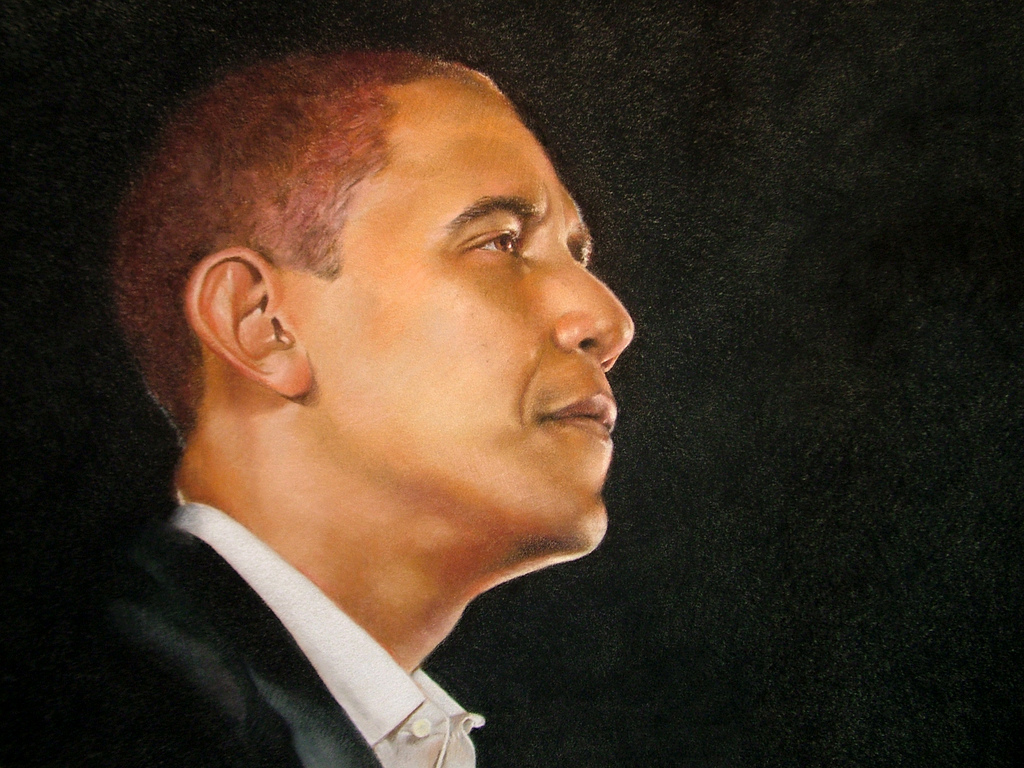
  • The Voice of the People

    cc:by-nc-sa-2.0/nicole caulfield
    President-Elect Barack Obama (cc:by-nc-sa-2.0/nicole caulfield)

    Had I gotten my address updated and my absentee ballot arrived in the mail, I would have either voted for John McCain, or abstained on account of my concerns over Palin’s qualifications. But most of America was more responsible than I was, and they voted. And they voted decisively.

    John McCain’s concession speech was magnanimous (though his supporters were disturbingly inclined to boo whenever the name “Obama” escaped from his lips). Whatever other people think of him, I do think McCain is genuinely interested in the welfare of his countrymen, and he showed that tonight as he exhorted us to support Barack Obama as he takes upon himself the heavy burden of the presidency. Senator McCain, I trust, will continue to serve his nation well as a principled deal-maker in the United States Senate. Much as he did during the extremes of Bush’s presidency, I expect that he will provide reasoned opposition alongside valuable experience.

    Senator Obama’s acceptance speech was humble, conciliatory, and yet inspiring. He quoted from Lincoln’s first inaugural address (I think) to good effect. Though he discounted the similarities between 2008 and 1861, we certainly need a president of the same caliber now as then to unite and to lead. Barack Obama certainly has the capacity to be that president.

    At any rate, though I feel my reasons for leaning towards McCain remain valid (free trade vs. economic protectionism, less likely to order a catastrophic Vietnamesque withdrawal in Iraq), and though I am deeply troubled about the reckless expansion of government entitlements likely to happen soon, I vow not to be a sore loser who just whines for the next four (or eight) years. Oh sure, I’ll criticize. But hopefully I will only do so having granted the new president the benefit of the doubt, and requiring all criticisms to be on the basis of principle rather than ad hominem.

    There are some things to look forward to under the upcoming administration. I’m particularly interested to see us kick the oil habit, and Obama seems poised to make something happen on that front. Personally I won’t be sad to see the Bush tax cuts expire since there was never decreased spending to accompany them. I anticipate improved relations abroad. And I think it will be cool to actually have little kids in the White House again for the first time in ages. Somehow it seems relate-to-able. Another obvious bonus is the powerful symbol Obama’s ascendancy is of America’s rejection of the bigotry of the past. Go equality!

    So anyway, congratulations to Senator Obama and his supporters. And here’s to a bright future for our country!

  • Choice, Compulsion, Popular Opinion, and the Public Interest

    Choice

    Relative to our own capability to act, believe, intend, or feel in various ways, choice is the process by which we actually do act, believe, intend, and feel. While some in the cognitive sciences feel that our choices may be entirely a product of chemical processes and circumstance, most people believe at some level that choice is a function of some inviolable personal free will or agency.

    For purposes of discussion, let [latex]\Omega[/latex] (omega) be the universe of all possible actions, beliefs, intents, and feelings. Let [latex]G[/latex] be a group of people, and let the range of actions, beliefs, intents, and feelings possible for [latex]G[/latex] be called [latex]X[/latex] and constrained by [latex]X \subseteq \Omega[/latex]. We could say that [latex]X = \bigcup_{g \in G}{X_g}[/latex] where [latex]X_g[/latex] for a given individual [latex]g[/latex] is the range of actions, beliefs, intents, and feelings possible for that individual.

    Compulsion

    We usually think of compulsion as forcing a person to undertake some action/belief/intent/feeling [latex]y[/latex]. Alternately, we can state more generally that compulsion is the ability to restrict a person’s or group of people’s [latex]X[/latex] arbitrarily. A person bound by options [latex]X_g[/latex] can operate within [latex]X_g[/latex]’s range of options. They can even limit themselves further to a smaller subset of [latex]X_g[/latex]. But they cannot operate outside of their own range of possibilities, in the space defined by [latex]\Omega – X_g[/latex]. Governments have some abilities to restrict or expand [latex]X_g[/latex] for an individual and [latex]X[/latex] for a group, though thankfully this sort of interference is significantly limited by constitutions in the United States and other countries. Theoretically, a totally despotic government could cause somebody to do an arbitrary [latex]y[/latex] by restricting their set of options until [latex]X_g = \left\{y\right\}[/latex] and [latex]y[/latex] is the only option left.

    Popular Opinion

    In society we tend to accept restrictions in some situations and oppose it in others. The acceptability of these restrictions seems to be governed both by legal processes and by the feelings of the public at large. Representative government still offers no perfect solution, but generally a tension of these two forces results in policy that reflects popular opinion except in certain cases where the law intervenes on behalf of minority groups.

    The Public Interest

    Ultimately, many instances of expanding [latex]X_g[/latex] for one person results in limiting [latex]X_g[/latex] for another. As stated previously, [latex]X = \bigcup_{g \in G}{X_g}[/latex]. If [latex]X_g[/latex] is not disjoint (i.e. there is overlap between various [latex]X_g[/latex]s), then the potential for conflict resides at [latex]X_a \cap X_b[/latex] for any [latex]a \in G[/latex] and [latex]b \in G[/latex]. So if one option in my [latex]X_g[/latex] is to park in parking spot 457, then, once I have parked there, parking in spot 457 is no longer an option for anyone else. So who says I can limit other people’s options like that? Well, perhaps I have purchased a parking pass for that spot—using prices to limit demand for a certain option can be effective.

    But for some instances of [latex]X_a \cap X_b[/latex] there is no established system of conflict resolution. So how should these conflicts (or potential conflicts) be dealt with? Are there some ground rules?

    The idea of “general welfare” can be helpful. Indeed, this is enshrined in the U.S. Constitution’s Preamble as one of the primary purposes for the existence of government. And even when it’s not explicitly invoked as a legal doctrine, general welfare is frequently a guiding force. For example, the substantial injury to the welfare of blacks who were denied the vote in the past was not outweighed by the minor, supposed benefit of a sense of superiority this allowed whites to carry around, and this fact was acknowledged when the judges deciding Brown v. the Board (I can’t remember the full case name) acted to “promote the general welfare.”

    We all hope that jurists, legislators, and executive officers will be wise and thoughtful judges of what will best promote the benefit of society as a whole. But do they always do so?