Category: the world

“[T]hings both in heaven and in the earth, and under the earth; things which have been, things which are, things which must shortly come to pass; things which are at home, things which are abroad; the wars and the perplexities of the nations, and the judgments which are on the land; and a knowledge also of countries and of kingdoms—” Doctrine and Covenants 88:79

  • Choice, Compulsion, Popular Opinion, and the Public Interest

    Choice

    Relative to our own capability to act, believe, intend, or feel in various ways, choice is the process by which we actually do act, believe, intend, and feel. While some in the cognitive sciences feel that our choices may be entirely a product of chemical processes and circumstance, most people believe at some level that choice is a function of some inviolable personal free will or agency.

    For purposes of discussion, let [latex]\Omega[/latex] (omega) be the universe of all possible actions, beliefs, intents, and feelings. Let [latex]G[/latex] be a group of people, and let the range of actions, beliefs, intents, and feelings possible for [latex]G[/latex] be called [latex]X[/latex] and constrained by [latex]X \subseteq \Omega[/latex]. We could say that [latex]X = \bigcup_{g \in G}{X_g}[/latex] where [latex]X_g[/latex] for a given individual [latex]g[/latex] is the range of actions, beliefs, intents, and feelings possible for that individual.

    Compulsion

    We usually think of compulsion as forcing a person to undertake some action/belief/intent/feeling [latex]y[/latex]. Alternately, we can state more generally that compulsion is the ability to restrict a person’s or group of people’s [latex]X[/latex] arbitrarily. A person bound by options [latex]X_g[/latex] can operate within [latex]X_g[/latex]’s range of options. They can even limit themselves further to a smaller subset of [latex]X_g[/latex]. But they cannot operate outside of their own range of possibilities, in the space defined by [latex]\Omega – X_g[/latex]. Governments have some abilities to restrict or expand [latex]X_g[/latex] for an individual and [latex]X[/latex] for a group, though thankfully this sort of interference is significantly limited by constitutions in the United States and other countries. Theoretically, a totally despotic government could cause somebody to do an arbitrary [latex]y[/latex] by restricting their set of options until [latex]X_g = \left\{y\right\}[/latex] and [latex]y[/latex] is the only option left.

    Popular Opinion

    In society we tend to accept restrictions in some situations and oppose it in others. The acceptability of these restrictions seems to be governed both by legal processes and by the feelings of the public at large. Representative government still offers no perfect solution, but generally a tension of these two forces results in policy that reflects popular opinion except in certain cases where the law intervenes on behalf of minority groups.

    The Public Interest

    Ultimately, many instances of expanding [latex]X_g[/latex] for one person results in limiting [latex]X_g[/latex] for another. As stated previously, [latex]X = \bigcup_{g \in G}{X_g}[/latex]. If [latex]X_g[/latex] is not disjoint (i.e. there is overlap between various [latex]X_g[/latex]s), then the potential for conflict resides at [latex]X_a \cap X_b[/latex] for any [latex]a \in G[/latex] and [latex]b \in G[/latex]. So if one option in my [latex]X_g[/latex] is to park in parking spot 457, then, once I have parked there, parking in spot 457 is no longer an option for anyone else. So who says I can limit other people’s options like that? Well, perhaps I have purchased a parking pass for that spot—using prices to limit demand for a certain option can be effective.

    But for some instances of [latex]X_a \cap X_b[/latex] there is no established system of conflict resolution. So how should these conflicts (or potential conflicts) be dealt with? Are there some ground rules?

    The idea of “general welfare” can be helpful. Indeed, this is enshrined in the U.S. Constitution’s Preamble as one of the primary purposes for the existence of government. And even when it’s not explicitly invoked as a legal doctrine, general welfare is frequently a guiding force. For example, the substantial injury to the welfare of blacks who were denied the vote in the past was not outweighed by the minor, supposed benefit of a sense of superiority this allowed whites to carry around, and this fact was acknowledged when the judges deciding Brown v. the Board (I can’t remember the full case name) acted to “promote the general welfare.”

    We all hope that jurists, legislators, and executive officers will be wise and thoughtful judges of what will best promote the benefit of society as a whole. But do they always do so?
  • Choose

    There comes a point for all of us where we simply have to make a decision: either we choose the flat, gray neutrality of belieflessness, or we choose to see the world in the dynamic contours of faith.

    When you believe in nothing—or, rather, when your belief is that there is no right or wrong, no good or bad—then everything becomes the same. Giving your grandma a hug versus, say, a punch in the face is totally neutral as far as morality, according to this view. The truly principled neutralitist will refuse to judge any one circumstance as being better than any other. But most adherents are quite human (as we all are) and succumb to considerations of self-interest. This totally relative comparison then pervades and colors everything, but, in essence, there is still only one reality: me. It’s not that pursuit of self-interest is inherently evil. But, of course, neither is it inherently good.

    When the morally-positive paradigm is assumed, on the other hand, another metric for choosing one thing over another comes into play. Aside from “What’s in it for me?” there comes to be “Is it right?” These two imperatives can be sharply divergent. It seems like, even sans penalties imposed by society, something like embezzlement would be highly approved of by the self-interest imperative, but disapproved of by the morality imperative. These moments of divergence often become a defining experience for the believer, for choosing something other than what raging self-interest dictates both proves and reinforces belief.

    There is no such divergence for the self-interested neutralitist, and thus there is no self to overcome, no hill to climb, no peak to summit, no view to behold. Just flat, boring, static neutrality. Even meeting all of the demands of self-interest brings no satisfaction for, in the neutral paradigm, after death there will be no “self” to remember how much of its interest was achieved, so why achieve it at all?

    Which leads to another issue: no morally neutral paradigm asserts anything about the post-death self other than “It ceases to exist.” Why is this? I believe it results from a combination of two things: first, if an individual first comes to believe that death is the end of the self, a moral neutrality frequently follows due to the elimination of incentives; second, though I’m purely speculating here, if an individual first comes to a stance of moral neutrality, belief in post-death persistence of self might suddenly seem irrelevant: if there’s no right or wrong here, then it’s probably because there isn’t any there either.

    Likewise any moral positivism that denies the persistence of self past death saps itself of much of the incentive for the believer to follow the moral imperative.

  • Lemmata

    Shocking fact: computers can’t do everything.

    I know, I know, all of those years living in delusion. But get up off the floor, it’s not that bad. You see, what a computer can’t do tells us at least as much about the computer as what it can do. Actually, to be more exact, what a computer can’t do is the exact opposite (the complement) of what a computer can do, so the two things delineate the same boundary. By knowing the limitations on a computer’s power, I feel like I know much more about it than if you gave me a list of 100 things the computer actually can do.

    For example, an extremely simple type of computer called a finite state automaton can be devised to do things like recognize all sequences of letters that end with the letter ‘z’, or that have five ‘a’s in a row. But, strangely, a finite state machine (that’s another name for finite state automaton) cannot do something so simple as telling you whether that sequence of letters has the same number of ‘a’s and ‘b’s in it. Weird.

    For each more sophisticated type of computer, there is a well-defined limit to its ability to solve problems. Usually this is demonstrated using a fancy proof called a lemma. These lemmata are learned and utilized by computer science students the world over. An interesting question resulting from this observation is whether the human mind has a similar limit. In other words, is there a problem that a human being, using reason alone, could not solve even with unlimited amounts of time and an infinite ability to remember things (and an infinite desire to just sit there crunching numbers)?

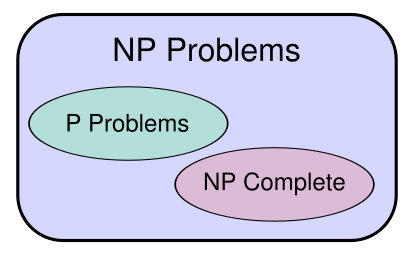
    414px-Complexity_classes.svgI’ve been discussing what’s known as computation theory. A related field, known as computational complexity theory, has similar implications. Rather than focusing on what a computer could theoretically compute with infinite time and memory, complexity theory focuses on how much time it takes to solve different problems. It turns out that many problems fall into a few basic classes, namely Polynomial (P), Non-deterministic Polynomial (NP), and NP Complete (NP-Complete). (For WAY more than you ever wanted to know about this topic, check out Stanford’s Complexity Garden and “Petting Zoo“.)

    I wouldn’t be at all surprised if human rationality, as its own special type of computer, runs into similar limits of complexity and computability. In “So Open It’s Closed” we ran into the difficulty of proving that genocide is bad, and yet the vast majority of human beings (myself definitely included) would agree that it is. What would happen if everybody took that lack of proof to heart and just went about rampaging and slaughtering the ethnic group that most recently got on their nerves?

    I consider this wall—against which human rationality can pound its head forever but never demonstrate anything—to be good evidence that our rationality is bounded. Not just in the sense of making expedient assumptions about things in order to save time and energy, but rather in the sense of what we can figure out over the long haul if we really put our minds to it. There’s a limit. We can see beyond it to a wider world around us, but we can’t quite escape from our complexity class prison, so most people just make long-term assumptions, assumptions which are vital to the development of both individuals and civilizations.

    Revealed religions claim a source of knowledge—a means of proof—other than human rationality. Western philosophy and folk argument frequently make claims that cannot be substantiated rationally, and yet are still believed in. Ultimately, whether people like it or not, beliefs in something nobody can prove keep us from destroying each other!

    Belief people “are endowed by their Creator with certain unalienable Rights, that among these are Life, Liberty and the pursuit of Happiness” would have steered humanity around such profound disasters as the Holocaust, Stalin’s Gulag death camps, the Chinese Cultural Revolution, the needless slaughter of European conquest in the Americas, etc. I see this as a support of the validity of those who teach such morals, especially Christ and the prophets, and a support of the necessity of seeking out “[our] Creator” in order to reach beyond the limits of our own rationality.

    There’s much to see, and I hope to see it. No finite state machine ever aspired so.